• Login
Upgrade
JStories
  • 日本語
  • 中文 (中国)
No Result
View All Result
  • Home
  • AI
    • Artificial Intelligence
    • Robotics
    • Mobility
  • Earth
    • Energy
    • Climate Tech
    • AgriTech
    • Clean Tech
    • Disaster Tech
    • SpaceTech
  • Life Sciences
    • BioTech
    • HealthTech
    • MedTech
    • AgeTech
  • Society
    • Media
    • EdTech
    • Diversity
    • FemTech
    • HRTech
    • LegalTech
    • Social Impact
    • FinTech
    • Anime
  • Lifestyle
    • FoodTech
    • FashionTech
    • BeautyTech
    • Wellbeing
    • Art & Music
  • Travel
    • Adventure Travel
    • Luxury Travel
    • Wellness & Medical Tourism
    • Culture
  • Video
  • Deals
    • Venture Capital
    • M&A
    • Startup Events
    • Pitch
    • Ecosystem Support
  • Interview
  • Opinion
  • Home
  • AI
    • Artificial Intelligence
    • Robotics
    • Mobility
  • Earth
    • Energy
    • Climate Tech
    • AgriTech
    • Clean Tech
    • Disaster Tech
    • SpaceTech
  • Life Sciences
    • BioTech
    • HealthTech
    • MedTech
    • AgeTech
  • Society
    • Media
    • EdTech
    • Diversity
    • FemTech
    • HRTech
    • LegalTech
    • Social Impact
    • FinTech
    • Anime
  • Lifestyle
    • FoodTech
    • FashionTech
    • BeautyTech
    • Wellbeing
    • Art & Music
  • Travel
    • Adventure Travel
    • Luxury Travel
    • Wellness & Medical Tourism
    • Culture
  • Video
  • Deals
    • Venture Capital
    • M&A
    • Startup Events
    • Pitch
    • Ecosystem Support
  • Interview
  • Opinion
en English ja 日本語 zh 中文 (中国)
JStories
No Result
View All Result

INTERVIEW | Bogdan Parkhomenko’s vision for Japan’s assistance in Ukraine’s reconstruction

Toshi Maeda by Toshi Maeda
07/21/2023
in Diversity, Earth, Media, Social Impact, Society
0
Home Society Diversity
Share on FacebookShare on Twitter

J-STORIES 1st anniversary interview series

J-STORIES is an international news service that provides information to investors, journalists, and others around the world. Its focus is innovative ESG (Environmental, Social, and Governance) and SDGs (Sustainable Development Goals) initiatives by Japanese companies, research institutions and startups in various fields. To mark the first anniversary of J-STORIES, we are speaking to a number of well-known individuals about the potential of such solutions from Japan.

J-STORIES – Bogdan Parkhomenko serves as a bridge between Japan, where he grew up, and his home country of Ukraine. He makes use of his fluency in Japanese to deliver fresh news from Ukraine’s capital of Kyiv to Japan. Ever since Russia first invaded Ukraine, he has used YouTube and other media to speak unreservedly about his own feelings, struggles, the damage in Ukraine, his family and friends, and many other things that have happened around him. But how does he think Japan can help Ukraine?

Note: this interview was recorded on 25 May via J-Stories’ World News audio feed on Twitter. The full version is available here.

Bogdan Parkhomenko was born in 1986 in the Ukrainian city of Dnipro. In 1990 he traveled to Japan with his parents, attended junior high school there, then returned to Ukraine where he went to university. Ever since he was a student, he has worked as an interpreter and coordinator for Japanese media. After graduating from university, he worked for a major trading company before founding his own company, SEPA LLC, which handles products from Japan and other nations. As well as running this company he seeks to be a bridge between Japan and Ukraine by actively communicating information via YouTube and other media.     Source: Bogdan Parkhomenko

Bogdan Parkhomenko sends information to Japan from Kyiv, the capital of Ukraine  where fierce fighting continues. He told J-Stories how he hopes that once there is some respite from the conflict Japan will help with the reconstruction effort to ensure everyday necessities such as electricity, water supply, and other infrastructure are restored by employing the private sector’s advanced capabilities.

In particular, he hopes that Japan’s start-ups will use their superior technology and know-how to restore an environment that has been heavily contaminated during the war.

“The water supply and the environment have been polluted by this war,” he says. “When the weather warmed up after spring, I was washing the windows of my house. They were firmly covered in something like oil, plastic, or charcoal that had come from drones that had been shot down, or destroyed missiles, and it was hard to wash off.”

“I see that kind of material not just on windows, but in the forests around here, and I think it finds its way into our lungs. So we have to completely remove it.”

In a report on environmental pollution in Ukraine last October, the United Nations Environment Programme (UNEP) stated that Ukraine, already burdened by a host of legacy environmental challenges, is “now facing a complex, multifaceted environmental crisis” that has either exacerbated existing issues, or created new ones. “It is essential that the ongoing conflict ends now to prevent greater damage to the environment and people,” the report adds.. “The country and the region risk being burdened with a toxic legacy long after the conflict ends.”

Regarding environmental pollution in Ukraine, the United Nations Environment Programme (UNEP) stated in its report last October that Ukraine is facing a complex and multifaceted environmental crisis. “Ukraine, already burdened by a host of legacy environmental challenges, is now facing a compounded, multi-dimensional environmental crisis that has either exacerbated existing issues or added new ones,” the report says. “It is essential that the ongoing conflict ends now to ensure greater damage to the environment and to people is averted,” it continues, adding  that if it fails to do so the country and the region “risk being burdened with a toxic legacy long after the conflict ends, as it must.”
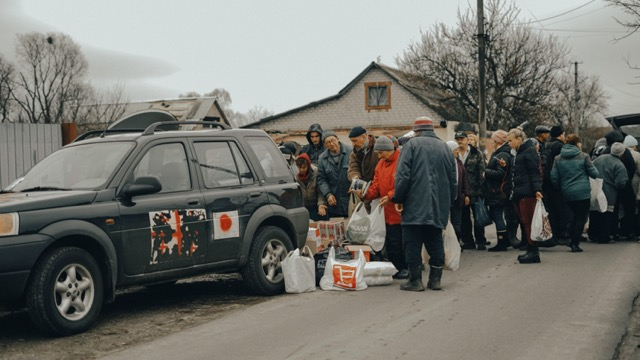
Parkhomenko and others distributing relief supplies in Ukraine.     Source: Bogdan Parkhomenko

Parkhomenko also said that Japan’s building technology is another area where he hopes for cooperation. He believes there will be a great need not just for high-quality engineering and construction technology to repair war-damaged roads in Ukraine, but also for Japanese companies that can build homes with shelters for use during future emergencies.

“I don’t know how many Japanese companies could build a house with a shelter, like those in Israel, but I think Japan is the world number one for construction technology, so it would be a great help to have such new houses… houses that can withstand missile and drone attacks.”

“Even before the war in Ukraine we had a certain amount of development of underground facilities, underground trains, and underground malls. We should make more use of Japanese technology, so that when something happens above ground we can go underground… and once you go down you can live safely there for months. It would be a help to have those houses. I have a very very strong wish for Japan to cooperate more in that area.”

https://www.youtube.com/watch?v=x0CU7cjdTFc

In the area of electrical power too, he hopes Japan can contribute with things like technological support for clean energy. “When it comes to electricity, Ukraine is a country with a relatively large production capacity, even to the extent we have exported (electrical power),” he says. “We are able to produce more than twice the amount we need domestically. But that electricity is all nuclear power, so I think it will be necessary to change to something more eco-friendly.”

On the other hand, Parkhomenko’s hope is that, as post-war reconstruction progresses, Ukraine can switch back to being an exporter with fertile land as it was before, and also return to being a country that can supply the food, electricity and other things Japan and the world needs.

“It’s not quite give-and-take, but Ukraine’s land is extremely rich and fertile, so we can farm those areas and boost trade to Europe. Also, Ukraine is a country of plains, so we can generate solar electricity, and by exporting that to Japan I think it can be useful to Japan and make Japan stronger.”

Translation by Tony McNicol

Top page photo by Bogdan Parkhomenko

For inquiries about this article, please contact jstories@pacficbridge.jp


Click here for the Japanese version of the article.

Tags: InterviewKyivNewsUkrainewar
Previous Post

Harmonizing tradition and technology with immersive sound experience

Next Post

Redefining gender roles to bridge ‘dream gap’ and unleash female ambitions

Toshi Maeda

Toshi Maeda

Related Posts

Japan leads global collaboration to combat AI disinformation
AI

Japan leads global collaboration to combat AI disinformation

by Ayaka Sagasaki
03/16/2026
Clean Tech

Japanese startup turns eggshell waste into eco-friendly plastics and paper

by Yoshiko Ohira
02/06/2026
Anime

World-first “anime character-based therapy” trial to test effectiveness in Japanese young adults

by Lucas Maltzman
01/30/2026
Earth

A world first: Detecting road sinkholes from space

by Ayaka Sagasaki
01/30/2026
Social Impact

From a childhood shaped by conflict to an investor bridging Japan and the world

by Ayaka Sagasaki
01/23/2026
Next Post

Redefining gender roles to bridge 'dream gap' and unleash female ambitions

Leave a Reply Cancel reply

Your email address will not be published. Required fields are marked *

Videos

Round-up Video #25

09/01/2022

Round-Up Video #39

12/22/2022

Round-Up Video #35

11/24/2022

Browse by Tags

Ai Alternative Energy biotechnology Climate Change Community decarbonization Education Event Food foodtech Health Inclusion Infrastructure Innovation Interview J-Stories Japan Japan-Taiwan Innovation Summit Japan startups Japan Tech Labor Living Nature Podcast Recycling Refugees robotics Society Space Startup Startup Ecosystem Startups SusHI Tech Tokyo Sustainability Sustainable Society Taiwan Technology Tokyo Tokyo Innovation Base Tokyo Metropolitan Government Tokyo Updates venture capital video Wealth Zero Waste
JStories

©Articles and photos published on JSTORIES are protected by Japanese copyright law and international treaties. They cannot be reproduced without the permission of the copyright holders

Explore JStories

  • About Jstories
  • Company
  • Contact
  • Home
  • Partner Press Releases
  • Pricing
  • Privacy Policy
  • Team

Follow Us

Welcome Back!

Login to your account below

Forgotten Password?

Retrieve your password

Please enter your username or email address to reset your password.

Log In
No Result
View All Result
  • Home
  • AI
    • Artificial Intelligence
    • Robotics
    • Mobility
  • Earth
    • Energy
    • Climate Tech
    • AgriTech
    • Clean Tech
    • Disaster Tech
    • SpaceTech
  • Life Sciences
    • BioTech
    • HealthTech
    • MedTech
    • AgeTech
  • Society
    • Media
    • EdTech
    • Diversity
    • FemTech
    • HRTech
    • LegalTech
    • Social Impact
    • FinTech
    • Anime
  • Lifestyle
    • FoodTech
    • FashionTech
    • BeautyTech
    • Wellbeing
    • Art & Music
  • Travel
    • Adventure Travel
    • Luxury Travel
    • Wellness & Medical Tourism
    • Culture
  • Video
  • Deals
    • Venture Capital
    • M&A
    • Startup Events
    • Ecosystem Support
  • Interview
  • Opinion

©Articles and photos published on JSTORIES are protected by Japanese copyright law and international treaties. They cannot be reproduced without the permission of the copyright holders

Are you sure want to unlock this post?
Unlock left : 0
Are you sure want to cancel subscription?