• Login
Upgrade
JStories
  • 日本語
  • 中文 (中国)
No Result
View All Result
  • Home
  • AI
    • Artificial Intelligence
    • Robotics
    • Mobility
  • Earth
    • Energy
    • Climate Tech
    • AgriTech
    • Clean Tech
    • Disaster Tech
    • SpaceTech
  • Life Sciences
    • BioTech
    • HealthTech
    • MedTech
    • AgeTech
  • Society
    • Media
    • EdTech
    • Diversity
    • FemTech
    • HRTech
    • LegalTech
    • Social Impact
    • FinTech
    • Anime
  • Lifestyle
    • FoodTech
    • FashionTech
    • BeautyTech
    • Wellbeing
    • Art & Music
  • Travel
    • Adventure Travel
    • Luxury Travel
    • Wellness & Medical Tourism
    • Culture
  • Video
  • Deals
    • Venture Capital
    • M&A
    • Startup Events
    • Pitch
    • Ecosystem Support
  • Interview
  • Opinion
  • Home
  • AI
    • Artificial Intelligence
    • Robotics
    • Mobility
  • Earth
    • Energy
    • Climate Tech
    • AgriTech
    • Clean Tech
    • Disaster Tech
    • SpaceTech
  • Life Sciences
    • BioTech
    • HealthTech
    • MedTech
    • AgeTech
  • Society
    • Media
    • EdTech
    • Diversity
    • FemTech
    • HRTech
    • LegalTech
    • Social Impact
    • FinTech
    • Anime
  • Lifestyle
    • FoodTech
    • FashionTech
    • BeautyTech
    • Wellbeing
    • Art & Music
  • Travel
    • Adventure Travel
    • Luxury Travel
    • Wellness & Medical Tourism
    • Culture
  • Video
  • Deals
    • Venture Capital
    • M&A
    • Startup Events
    • Pitch
    • Ecosystem Support
  • Interview
  • Opinion
en English ja 日本語 zh 中文 (中国)
JStories
No Result
View All Result

The elite tree revolution: Japan’s new forestry frontier

Yui Sawada by Yui Sawada
02/23/2024
in AgriTech, Clean Tech, Climate Tech, Earth
0
Home Earth AgriTech
Share on FacebookShare on Twitter

J-STORIES – There are ordinary trees. Then there are elite trees. At least, in terms of special properties. Elite trees are special saplings selected by the Minister of Agriculture, Forestry and Fisheries (MAFF) from about 9,000 of the best cedar, cypress and larch trees grown in artificial forests.

These trees got the “elite” tag for their ability to absorb 1.5 times more carbon dioxide. They will help accelerate forest carbon sink measures, or the amount of CO2 absorbed by forests. Elite trees boast high rigidity that is suitable for timber use, and produce less than half of pollen amount, which is good in combating hay fever. They are expected to reduce the amount of undercutting and shorten the felling process, which will reduce labor and costs. To strengthen pollen control, MAFF aims to increase the number of elite trees to 30% of forestry seedlings by 2030 and to more than 90% by 2050.

Regular Japanese cedar and cypresses, the most abundant trees in Japan, reach maturity in about 40 years, after which their ability to absorb CO2 declines. According to the Forestry Agency in Japan, more than half of Japan’s planted forests are already over 50 years old. If forests continue to age at this current rate, they will become less effective at deoxygenating the atmosphere. The situation is critical to achieving carbon neutrality by 2050.
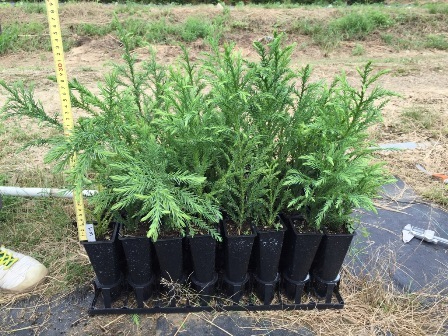
Cuttings of Japanese cedar      Source:Nippon Paper Industries

Nippon Paper Industries, which owns 90,000 hectares of company-owned forests in Japan, became the first private company to begin mass production and sales of the elite tree seedlings.
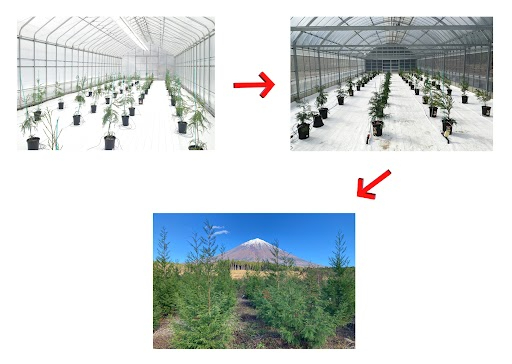
 The tree growth process from sapling to mature tree (photo)     Source:Nippon Paper Industries

In October 2023, the company qualified as a business operator in six prefectures (Akita, Shizuoka, Oita, Hiroshima, Tottori, and Kumamoto) and opened seed and scion collection orchards. The company plans to establish a system to produce 10 million elite tree seedlings per year by the end of FY2030.
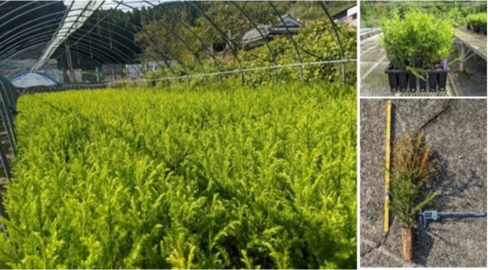
Trees to be grown in plastic greenhouses      Source:Nippon Paper Industries

The company is also involved in overseas afforestation projects. In Brazil, a method for selecting superior trees based on DNA analysis of eucalyptus trees in a Brazilian afforestation area is now in the practical stage. In the future, the company intends to expand this breeding technology to Southeast Asia and other regions. The company will also promote efforts to increase the efficiency of papermaking raw material procurement and decarbonization efforts to increase CO2 absorption around the world.

Translation by Tony McNicol

Editing by Desiderio Luna

Photos provided by Nippon Paper Industries

For inquiries about this article, please contact jstories@pacificbridge.jp


Click here for the Japanese version of the article.
Tags: AfforestationbiotechnologyCarbon Neutrality 2050Carbon SinkCO2 AbsorptionDNA AnalysisElite TreesForestry AgencyHay Fever CountermeasuresJapan TechJapanese CedarNippon Paper IndustriesSustainable Forestry
Previous Post

Advanced near-infrared absorbing material turns sunlight into heat

Next Post

1st Japan Global Innovators’ Forum (JGIF)

Yui Sawada

Yui Sawada

Related Posts

Clean Tech

Japanese startup turns eggshell waste into eco-friendly plastics and paper

by Yoshiko Ohira
02/06/2026
Earth

A world first: Detecting road sinkholes from space

by Ayaka Sagasaki
01/30/2026
AgriTech

Fish scraps as a hidden treasure

by Kei Mizuno
01/16/2026
AgriTech

Can a small robot save Japan’s terraced paddies?

by Yoshiko Ohira
11/28/2025
Clean Tech

From swordfish to blue jeans: How a Japanese craftsman turns waste into wear

by Yoshiko Ohira
11/07/2025
Next Post

1st Japan Global Innovators' Forum (JGIF)

Leave a Reply Cancel reply

Your email address will not be published. Required fields are marked *

Videos

Round-up Video #27

09/22/2022

Round-Up Video #39

12/22/2022

Round-up Video #25

09/01/2022

Browse by Tags

Ai Alternative Energy biotechnology Climate Change Community decarbonization Education Event Food foodtech Health Inclusion Infrastructure Innovation Interview J-Stories Japan Japan-Taiwan Innovation Summit Japan startups Japan Tech Labor Living Nature Podcast Recycling Refugees robotics Society Space Startup Startup Ecosystem Startups SusHI Tech Tokyo Sustainability Sustainable Society Taiwan Technology Tokyo Tokyo Innovation Base Tokyo Metropolitan Government Tokyo Updates venture capital video Wealth Zero Waste
JStories

©Articles and photos published on JSTORIES are protected by Japanese copyright law and international treaties. They cannot be reproduced without the permission of the copyright holders

Explore JStories

  • About Jstories
  • Company
  • Contact
  • Home
  • Partner Press Releases
  • Pricing
  • Privacy Policy
  • Team

Follow Us

Welcome Back!

Login to your account below

Forgotten Password?

Retrieve your password

Please enter your username or email address to reset your password.

Log In
No Result
View All Result
  • Home
  • AI
    • Artificial Intelligence
    • Robotics
    • Mobility
  • Earth
    • Energy
    • Climate Tech
    • AgriTech
    • Clean Tech
    • Disaster Tech
    • SpaceTech
  • Life Sciences
    • BioTech
    • HealthTech
    • MedTech
    • AgeTech
  • Society
    • Media
    • EdTech
    • Diversity
    • FemTech
    • HRTech
    • LegalTech
    • Social Impact
    • FinTech
    • Anime
  • Lifestyle
    • FoodTech
    • FashionTech
    • BeautyTech
    • Wellbeing
    • Art & Music
  • Travel
    • Adventure Travel
    • Luxury Travel
    • Wellness & Medical Tourism
    • Culture
  • Video
  • Deals
    • Venture Capital
    • M&A
    • Startup Events
    • Ecosystem Support
  • Interview
  • Opinion

©Articles and photos published on JSTORIES are protected by Japanese copyright law and international treaties. They cannot be reproduced without the permission of the copyright holders

Are you sure want to unlock this post?
Unlock left : 0
Are you sure want to cancel subscription?