• Login
Upgrade
JStories
  • 日本語
  • 中文 (中国)
No Result
View All Result
  • Home
  • AI
    • Artificial Intelligence
    • Robotics
    • Mobility
  • Earth
    • Energy
    • Climate Tech
    • AgriTech
    • Clean Tech
    • Disaster Tech
    • SpaceTech
  • Life Sciences
    • BioTech
    • HealthTech
    • MedTech
    • AgeTech
  • Society
    • Media
    • EdTech
    • Diversity
    • FemTech
    • HRTech
    • LegalTech
    • Social Impact
    • FinTech
    • Anime
  • Lifestyle
    • FoodTech
    • FashionTech
    • BeautyTech
    • Wellbeing
    • Art & Music
  • Travel
    • Adventure Travel
    • Luxury Travel
    • Wellness & Medical Tourism
    • Culture
  • Video
  • Deals
    • Venture Capital
    • M&A
    • Startup Events
    • Pitch
    • Ecosystem Support
  • Interview
  • Opinion
  • Home
  • AI
    • Artificial Intelligence
    • Robotics
    • Mobility
  • Earth
    • Energy
    • Climate Tech
    • AgriTech
    • Clean Tech
    • Disaster Tech
    • SpaceTech
  • Life Sciences
    • BioTech
    • HealthTech
    • MedTech
    • AgeTech
  • Society
    • Media
    • EdTech
    • Diversity
    • FemTech
    • HRTech
    • LegalTech
    • Social Impact
    • FinTech
    • Anime
  • Lifestyle
    • FoodTech
    • FashionTech
    • BeautyTech
    • Wellbeing
    • Art & Music
  • Travel
    • Adventure Travel
    • Luxury Travel
    • Wellness & Medical Tourism
    • Culture
  • Video
  • Deals
    • Venture Capital
    • M&A
    • Startup Events
    • Pitch
    • Ecosystem Support
  • Interview
  • Opinion
en English ja 日本語 zh 中文 (中国)
JStories
No Result
View All Result

Japan’s NTT uses drone to capture and redirect lightning strikes in world first

Ayaka Sagasaki by Ayaka Sagasaki
08/07/2025
in AI, Climate Tech, Disaster Tech, Earth, Energy, Mobility, Robotics, Social Impact, Society
0
Home AI
Share on FacebookShare on Twitter

JStories ー Japan’s largest telco NTT, Inc. said it has succeeded in an experiment using drones to trigger and guide lightning, marking a world-first achievement. While triggering lightning itself has been done before, NTT’s use of drones to control lightning is an entirely new approach. The breakthrough, announced in April 2025, represents a dramatic shift in how countries could defend their cities, people, and critical systems from natural disasters

“When lightning strikes our communications infrastructure, it can shut down entire regional networks,” says Atsushi Nagao, senior researcher at NTT Space Environment and Energy Laboratories.
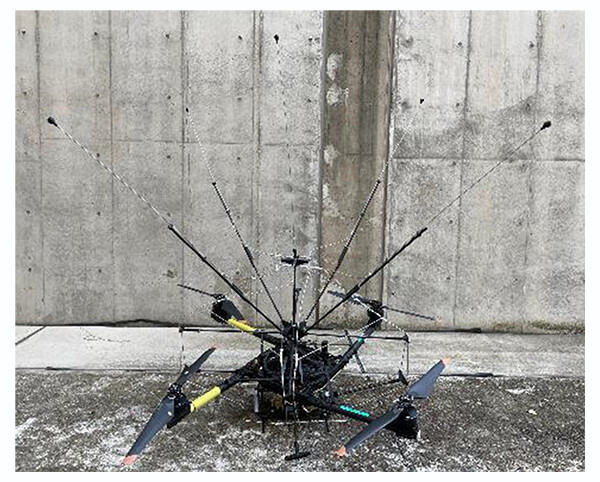
Between December 2024 and January 2025, NTT deployed a drone equipped with conductive wire to attempt artificial lightning induction during lightning activity in the mountainous region of Shimane Prefecture, Japan (elevation 900m)   Photo courtesy of NTT, Inc. (Same below)

Facing the damage

As climate change intensifies, lightning strikes are becoming more frequent and destructive across the globe. In Japan alone, annual damage to infrastructure and property is estimated at between ¥100 billion and ¥200 billion. While the lightning rod—developed in the mid-18th century—remains the primary method of protection, even its modern iterations cannot fully prevent damage.

“No matter how many precautions we take, it’s impossible to eliminate the damage completely,” says Nagao. “So we flipped the concept from trying to avoid lightning, to intentionally capturing and safely diverting it.”
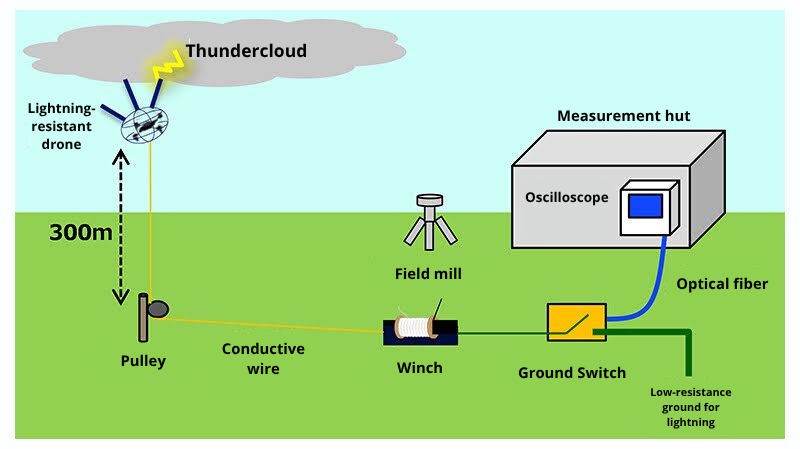
When the electric field strengthened, the drone—connected to the ground via a switch that closed the circuit—was flown up to 300 meters     Translated by JStories
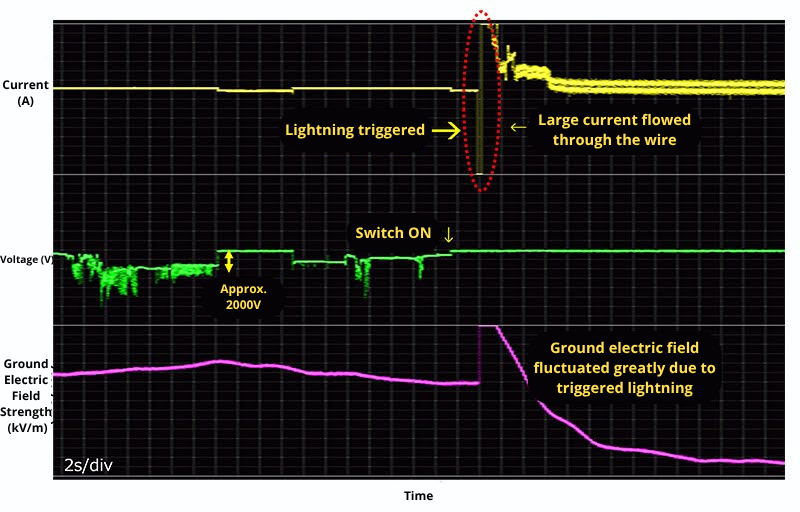
A large current flowed through the wire, and researchers confirmed changes in the surrounding electric field intensity, which were observed as a result of the induced lightning strike         Translated by JStories

Two key technologies

In NTT’s experiment, researchers moved a drone into position under an active thundercloud. The drone is then connected to the ground via a high-voltage switch to trigger a lightning discharge. Two key technologies were developed to make this possible.

NTT engineered a lightning-proof cage to protect the drone from being destroyed by a direct lightning strike. The cage acts as a metallic shield that redirects the current flow away from the core systems. The design also mitigates the intense magnetic fields caused by lightning, allowing the drone to remain stable and operational.
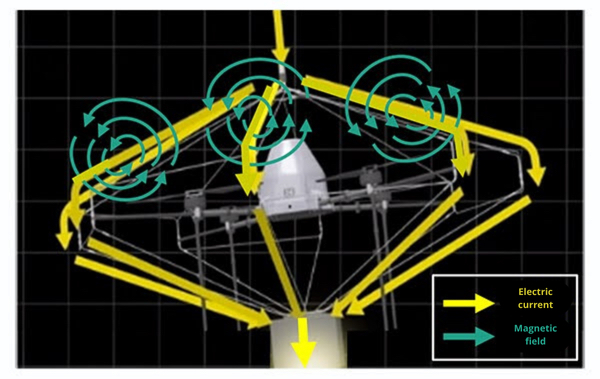
The custom-designed lightning protection cage redirects electric currents and cancels magnetic interference to protect the drone      Translated by JStories

The second breakthrough involves manipulating electric-field intensity to induce a strike. The airborne drone is connected to the ground via a long, conductive wire. A ground-based high-voltage switch is used to change the drone’s surrounding electric field at precisely the right moment—prompting lightning to strike the wire rather than random targets.
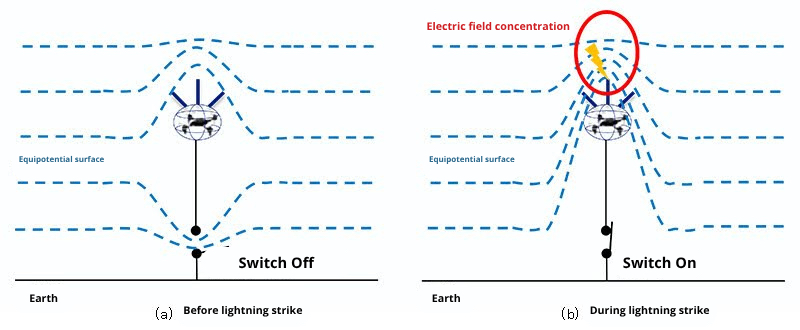
At the optimal moment, the system connects the drone and ground, causing a rapid spike in local electric field strength and successfully inducing lightning

While researchers in the past have triggered lightning using rockets or lasers, these efforts were purely experimental and not intended for real-world applications. What makes our work unique,” says Nagao, “is that we’re designing this technology for practical use—to protect people and infrastructure. Our goal is to have it operational by around 2030”

But there are challenges: predicting where and when lightning will strike is still a work in progress, and ensuring the system is safe around people requires further development.

Lightning as renewable energy?

In addition to lightning control, NTT is exploring whether lightning can be harnessed as a renewable energy source. “One lightning bolt contains roughly 400 kilowatt-hours, enough to power a family of four for a month,” Nagao explains. “Exactly how much of that energy we can store is still unknown, but we’re working on methods to make it possible.”
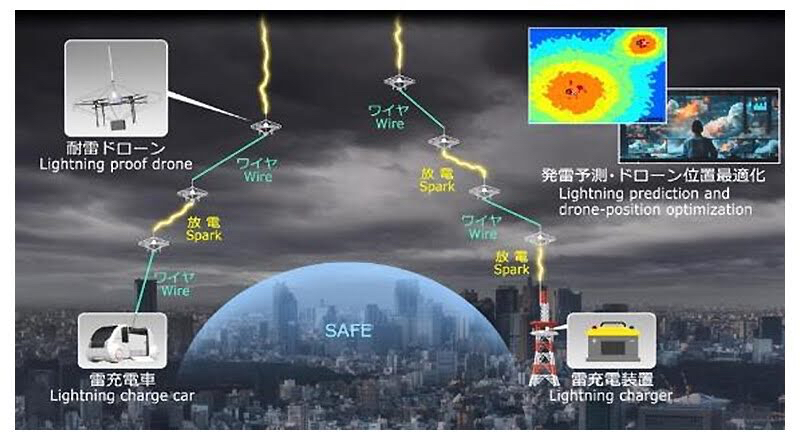
NTT aims to not only redirect lightning with drones, but also store its energy for future use

NTT’s breakthrough has already attracted attention  both domestically and internationally, reflecting the growing interest in this innovative technology. Wind farms, for instance, often suffer lightning damage, but can’t be protected with standard lightning rods due to their location. This drone-based method could be a game-changer.

The same goes for outdoor concerts and sports events. Traditional lightning prevention infrastructure isn’t cost-effective for temporary venues—but with drones, protection can be deployed only when needed.

“We hope this technology will help protect people all over the world from the increasing danger of lightning,” says Nagao.

Translated by Anita De Michele | JStories

Edited by Kwee Chuan Yeo | JStories

Top photo: Envato

For inquiries regarding this article, please contact jstories@pacificbridge.jp


Click here for the Japanese version of the article

Tags: Climate AdaptationDisastertechdroneDronesEnergyInfrastructureInnovationInterviewJapanlightingTechnologyworld first
Previous Post

INTERVIEW | The shape of corporate investment born from problem-solving: What is CVC 4.0?

Next Post

From river source to “sweet dew”: The technology and commitment behind Tokyo’s high-quality tap water

Ayaka Sagasaki

Ayaka Sagasaki

Related Posts

Japan leads global collaboration to combat AI disinformation
AI

Japan leads global collaboration to combat AI disinformation

by Ayaka Sagasaki
03/16/2026
Clean Tech

Japanese startup turns eggshell waste into eco-friendly plastics and paper

by Yoshiko Ohira
02/06/2026
Anime

World-first “anime character-based therapy” trial to test effectiveness in Japanese young adults

by Lucas Maltzman
01/30/2026
Earth

A world first: Detecting road sinkholes from space

by Ayaka Sagasaki
01/30/2026
Social Impact

From a childhood shaped by conflict to an investor bridging Japan and the world

by Ayaka Sagasaki
01/23/2026
Next Post

From river source to “sweet dew”: The technology and commitment behind Tokyo’s high-quality tap water

Leave a Reply Cancel reply

Your email address will not be published. Required fields are marked *

Videos

Taking action for peace

11/30/2022

INTERVIEW | Taking action for peace

11/30/2022

One-of-a-kind marriage certificates strengthen marital bond

11/17/2023

Browse by Tags

Ai Alternative Energy biotechnology Climate Change Community decarbonization Education Event Food foodtech Health Inclusion Infrastructure Innovation Interview J-Stories Japan Japan-Taiwan Innovation Summit Japan startups Japan Tech Labor Living Nature Podcast Recycling Refugees robotics Society Space Startup Startup Ecosystem Startups SusHI Tech Tokyo Sustainability Sustainable Society Taiwan Technology Tokyo Tokyo Innovation Base Tokyo Metropolitan Government Tokyo Updates venture capital video Wealth Zero Waste
JStories

©Articles and photos published on JSTORIES are protected by Japanese copyright law and international treaties. They cannot be reproduced without the permission of the copyright holders

Explore JStories

  • About Jstories
  • Company
  • Contact
  • Home
  • Partner Press Releases
  • Pricing
  • Privacy Policy
  • Team

Follow Us

Welcome Back!

Login to your account below

Forgotten Password?

Retrieve your password

Please enter your username or email address to reset your password.

Log In
No Result
View All Result
  • Home
  • AI
    • Artificial Intelligence
    • Robotics
    • Mobility
  • Earth
    • Energy
    • Climate Tech
    • AgriTech
    • Clean Tech
    • Disaster Tech
    • SpaceTech
  • Life Sciences
    • BioTech
    • HealthTech
    • MedTech
    • AgeTech
  • Society
    • Media
    • EdTech
    • Diversity
    • FemTech
    • HRTech
    • LegalTech
    • Social Impact
    • FinTech
    • Anime
  • Lifestyle
    • FoodTech
    • FashionTech
    • BeautyTech
    • Wellbeing
    • Art & Music
  • Travel
    • Adventure Travel
    • Luxury Travel
    • Wellness & Medical Tourism
    • Culture
  • Video
  • Deals
    • Venture Capital
    • M&A
    • Startup Events
    • Ecosystem Support
  • Interview
  • Opinion

©Articles and photos published on JSTORIES are protected by Japanese copyright law and international treaties. They cannot be reproduced without the permission of the copyright holders

Are you sure want to unlock this post?
Unlock left : 0
Are you sure want to cancel subscription?