• Login
Upgrade
JStories
  • 日本語
  • 中文 (中国)
No Result
View All Result
  • Home
  • AI
    • Artificial Intelligence
    • Robotics
    • Mobility
  • Earth
    • Energy
    • Climate Tech
    • AgriTech
    • Clean Tech
    • Disaster Tech
    • SpaceTech
  • Life Sciences
    • BioTech
    • HealthTech
    • MedTech
    • AgeTech
  • Society
    • Media
    • EdTech
    • Diversity
    • FemTech
    • HRTech
    • LegalTech
    • Social Impact
    • FinTech
    • Anime
  • Lifestyle
    • FoodTech
    • FashionTech
    • BeautyTech
    • Wellbeing
    • Art & Music
  • Travel
    • Adventure Travel
    • Luxury Travel
    • Wellness & Medical Tourism
    • Culture
  • Video
  • Deals
    • Venture Capital
    • M&A
    • Startup Events
    • Pitch
    • Ecosystem Support
  • Interview
  • Opinion
  • Home
  • AI
    • Artificial Intelligence
    • Robotics
    • Mobility
  • Earth
    • Energy
    • Climate Tech
    • AgriTech
    • Clean Tech
    • Disaster Tech
    • SpaceTech
  • Life Sciences
    • BioTech
    • HealthTech
    • MedTech
    • AgeTech
  • Society
    • Media
    • EdTech
    • Diversity
    • FemTech
    • HRTech
    • LegalTech
    • Social Impact
    • FinTech
    • Anime
  • Lifestyle
    • FoodTech
    • FashionTech
    • BeautyTech
    • Wellbeing
    • Art & Music
  • Travel
    • Adventure Travel
    • Luxury Travel
    • Wellness & Medical Tourism
    • Culture
  • Video
  • Deals
    • Venture Capital
    • M&A
    • Startup Events
    • Pitch
    • Ecosystem Support
  • Interview
  • Opinion
en English ja 日本語 zh 中文 (中国)
JStories
No Result
View All Result

A pocket-size AED innovation to save more lives

Suvendrini Kakuchi by Suvendrini Kakuchi
09/11/2025
in AI, Artificial Intelligence, Diversity, HealthTech, Life Sciences, MedTech, Robotics, Social Impact, Society
0
Home AI
Share on FacebookShare on Twitter

JStories ー A Japanese startup has developed a pocket-size automated external defibrillator (AED) — about the size and weight of an iPhone — that could put life-saving equipment into far more hands. “The new AED is a game changer,” said Dr. Toshio Chiba, a former fetal surgeon and CEO of the startup, Onlinemaster Co., explaining that damage from impaired blood flow to the brain can be drastically reduced when life-saving measures are taken immediately. Chiba spent more than three years refining the device to make it compact, reliable, and easy to use.
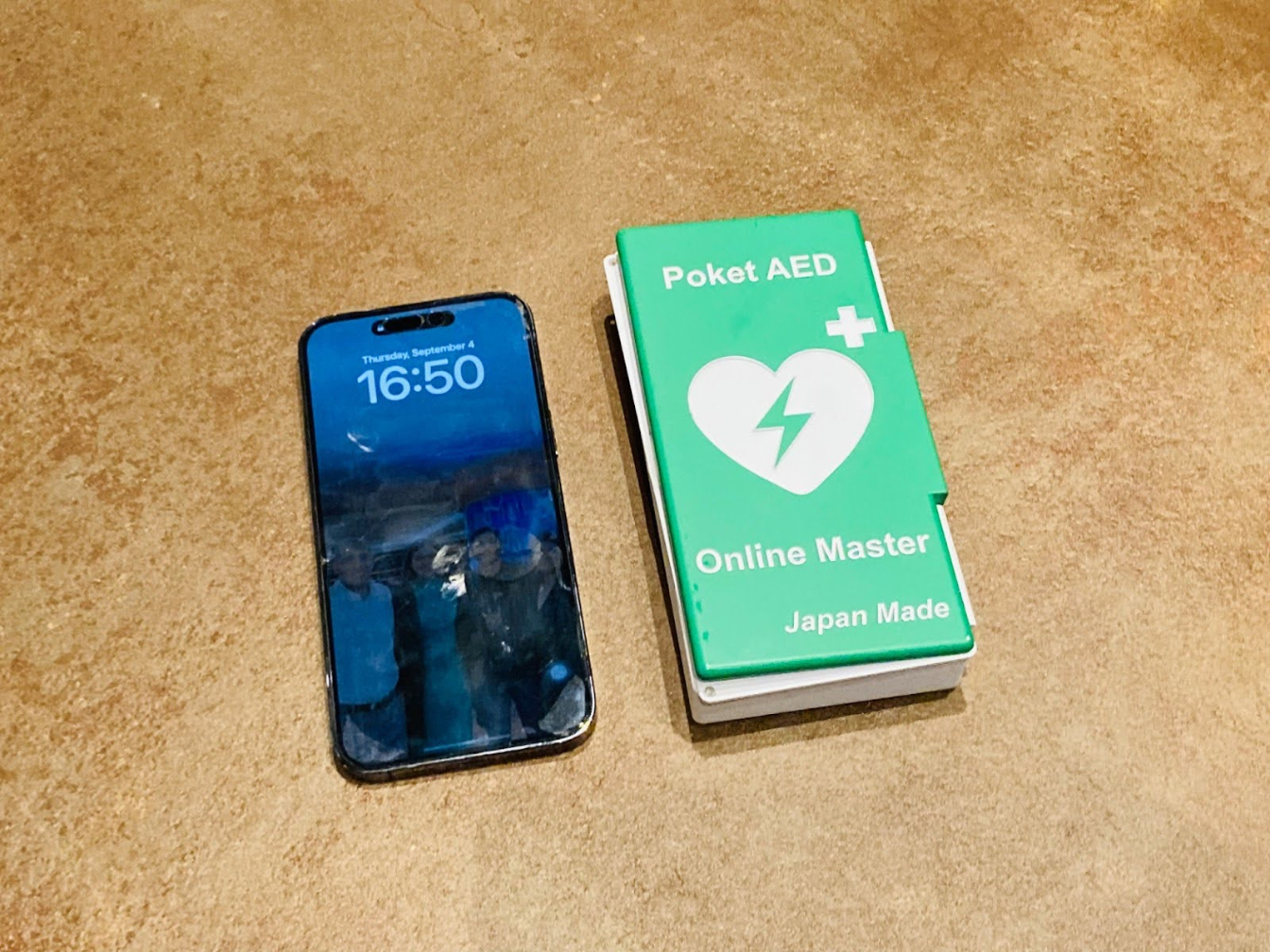
A pocket-size AED, right, shown next to a smartphone. The compact device can easily fit into a handbag or shirt pocket    Photo courtesy of Onlinemaster Co. (Same below)

Chiba’s prototype does away with condensers that are usually installed in AEDs. A condenser weighs almost 2 kilograms—eradicating it represents a significant breakthrough. “It is replaced with a unique circuit system designed to freely control the waveform of the electric shock, reducing the intensity on the patient’s body,” he explained. Inventing the portable AED was not a straightforward process. To create the prototype, Chiba said existing devices were taken apart and their limitations were examined before they were rebuilt into a more compact, efficient form. “My innovation highlights the importance of reverse engineering,” he said.
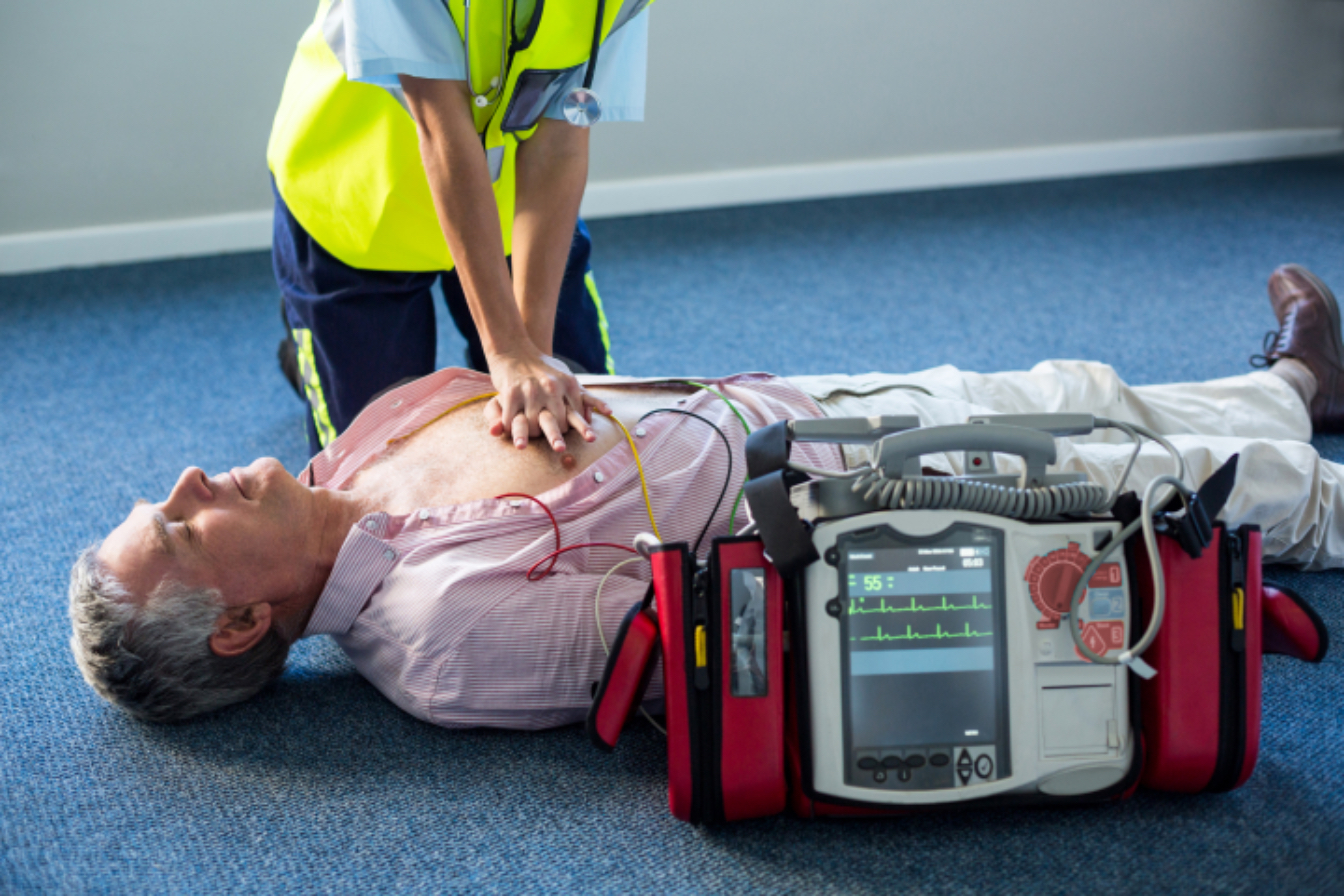
A standard automated external defibrillator (AED) in use during CPR      Source: Envato

Chiba’s prototype AED is also equipped with double sequential external defibrillation capacity. What this means is that it is capable of delivering two shocks, doubling the capacity of a regular AED, marking a first in the world. Behind the invention is Chiba and his diverse team at Onlinemaster. Launched in 2021, the company works under a collaborative business model with a team consisting of scientists, tech experts and companies—the goal is to develop new medical devices in Japan and reduce reliance on imports.
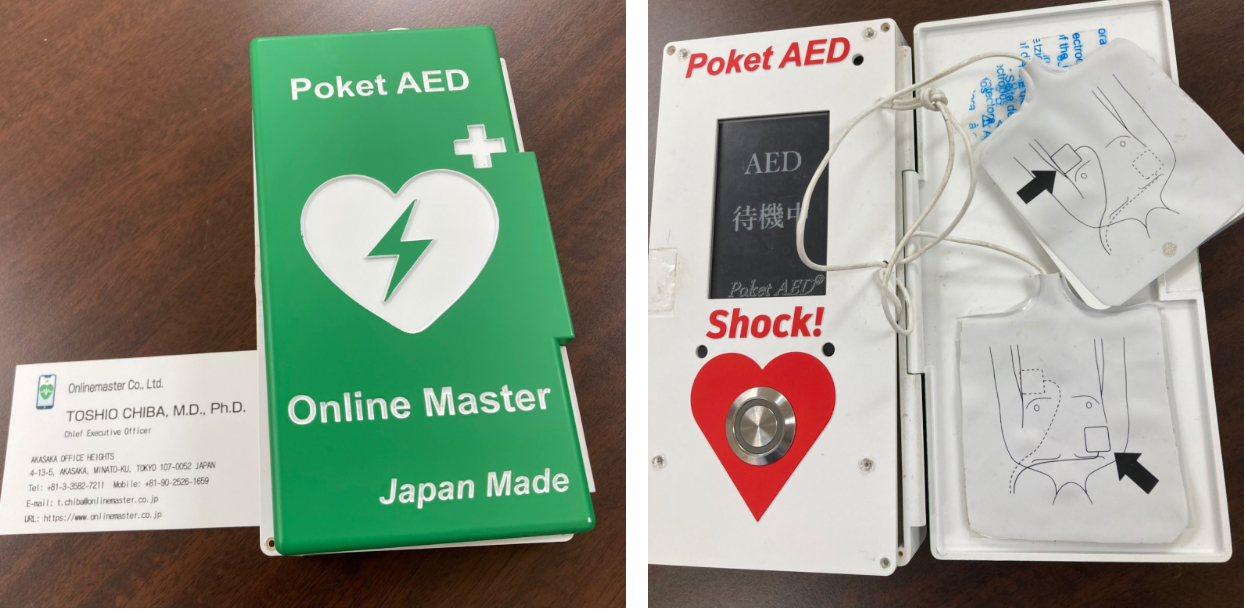
Outside (left) and inside (right) view of the pocket AED, which includes two electrode pads for quick placement on the chest during a cardiac emergency      Photo courtesy of Onlinemaster Co. (Same below)

Chiba’s patented AED innovation is on the cusp of entering the commercial market, after completing animal testing at Toho Medical University in 2023. The prototype represents a significant departure from the current bulky orange-colored AEDs available in Japan. Weighing between 200 and 300 grams, the new AED can be tucked into a handbag or shirt pocket, and its target users include women and children.
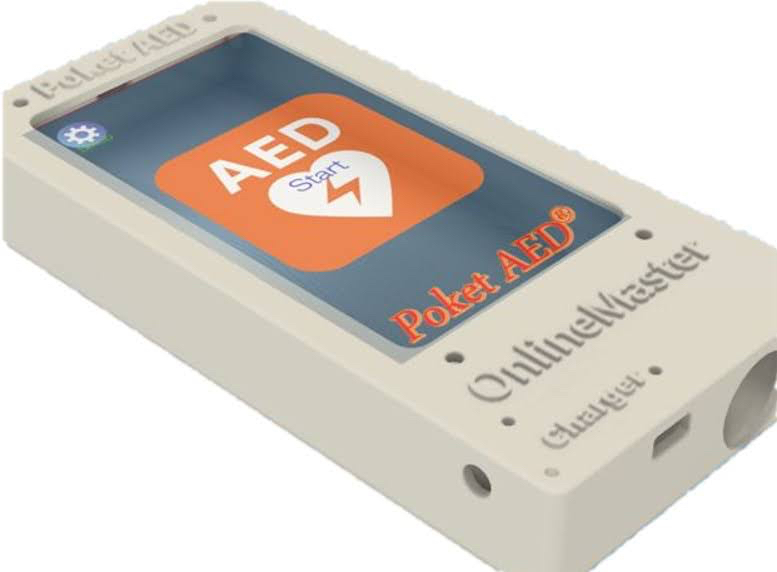
The pocket-size AED was developed by taking apart existing devices to study their limitations and rebuild them in a more compact, efficient form

Data regarding AED use in Japan shows the criticality of his innovation, said Chiba. According to the Japan AED Foundation, just 4.96% of the country’s AEDs are actually used on-site. Meanwhile, when life-saving intervention is delayed, survival from cardiac arrest drops to around 3%, underscoring the urgency of faster access to AEDs. Ambulances also take an average of at least 10 minutes to arrive at the scene, according to the Fire and Disaster Management Agency.

“The situation is particularly disturbing in Japan when you consider the fact we have the highest AEDs in use in the world,” said Chiba. Almost 1.6 million AEDs have been sold in Japan as of 2023, according to the Japan Heart Foundation. Japan is considered one of the countries with the highest number of AEDs in the world.

Chiba’s Pocket AED® was displayed in June at the Japan External Trade Organization pavilion during the Japan Health international exhibition, which was held as part of the Osaka Expo’s Health & Wellbeing Week. The product resembles a slim vertical box with a flap that opens to reveal two electrode pads to be placed on the victim’s chest. “We designed it so that even someone with no medical training can use it immediately,” Chiba said.
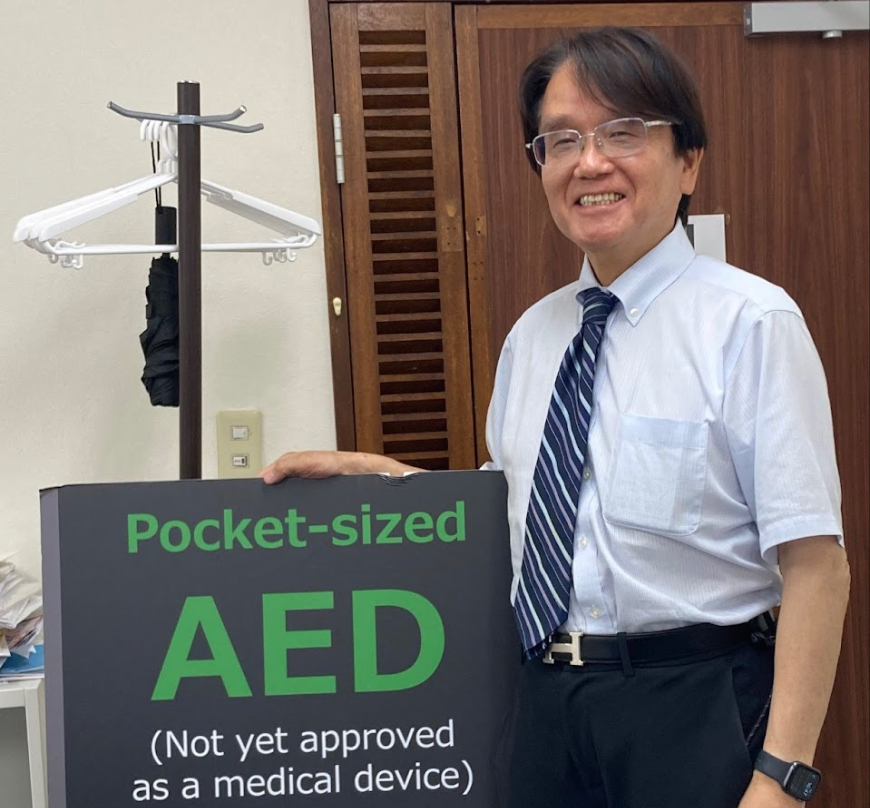
Toshio Chiba, a former fetal surgeon and CEO of Onlinemaster Co., poses during an interview with JStories     Photo by Suvendrini Kakuchi 

The idea for the groundbreaking invention was planted when Chiba was returning home one evening and saw a man clutching his chest, collapsed at a train station. The doctor rushed to administer CPR (cardiopulmonary resuscitation) as he waited for station staff to bring an AED. The man survived but the delayed response revealed the risks faced by the public in medical emergencies, which Chiba said he has repeatedly encountered in Japan. “My dream was to bring a desperately needed change,” he said.

In line with that ambition,  Chiba set up the Medical Innovation Consortium in 2012,  a group that brings together doctors, researchers, and engineers to apply new technologies to healthcare. The consortium not only develops medical devices but also promotes public training as part of its mission. “Bringing innovation to people is critical for successful change,” said Chiba.

Written by Suvendrini Kakuchi

Edited by Kwee Chuan Yeo | JStories

Top photo: Envato

For inquiries regarding this article, please contact jstories@pacificbridge.jp


Click here for the Japanese version of the article

Tags: AEDCPREmergency ResponseHealthcare InnovationInterviewJapanMedTechPocket AEDStartupTokyo
Previous Post

Water supply independent of plumbing: A new normal for sustainable water infrastructure

Next Post

Tokyo startup taps hot spring microbe to combat climate change

Suvendrini Kakuchi

Suvendrini Kakuchi

Related Posts

Japan leads global collaboration to combat AI disinformation
AI

Japan leads global collaboration to combat AI disinformation

by Ayaka Sagasaki
03/16/2026
HealthTech

Engineering safety from the ground up

by Tokyo Updates
02/13/2026
Anime

World-first “anime character-based therapy” trial to test effectiveness in Japanese young adults

by Lucas Maltzman
01/30/2026
Social Impact

From a childhood shaped by conflict to an investor bridging Japan and the world

by Ayaka Sagasaki
01/23/2026
BioTech

Toward a targeted therapy with fewer side effects for chronic allergic eye disease

by Yoshiko Ohira
01/08/2026
Next Post

Tokyo startup taps hot spring microbe to combat climate change

Leave a Reply Cancel reply

Your email address will not be published. Required fields are marked *

Videos

Round-Up Video #31

10/27/2022

Round-Up Video #32

11/03/2022

Round-up Video #29

10/06/2022

Browse by Tags

Ai Alternative Energy biotechnology Climate Change Community decarbonization Education Event Food foodtech Health Inclusion Infrastructure Innovation Interview J-Stories Japan Japan-Taiwan Innovation Summit Japan startups Japan Tech Labor Living Nature Podcast Recycling Refugees robotics Society Space Startup Startup Ecosystem Startups SusHI Tech Tokyo Sustainability Sustainable Society Taiwan Technology Tokyo Tokyo Innovation Base Tokyo Metropolitan Government Tokyo Updates venture capital video Wealth Zero Waste
JStories

©Articles and photos published on JSTORIES are protected by Japanese copyright law and international treaties. They cannot be reproduced without the permission of the copyright holders

Explore JStories

  • About Jstories
  • Company
  • Contact
  • Home
  • Partner Press Releases
  • Pricing
  • Privacy Policy
  • Team

Follow Us

Welcome Back!

Login to your account below

Forgotten Password?

Retrieve your password

Please enter your username or email address to reset your password.

Log In
No Result
View All Result
  • Home
  • AI
    • Artificial Intelligence
    • Robotics
    • Mobility
  • Earth
    • Energy
    • Climate Tech
    • AgriTech
    • Clean Tech
    • Disaster Tech
    • SpaceTech
  • Life Sciences
    • BioTech
    • HealthTech
    • MedTech
    • AgeTech
  • Society
    • Media
    • EdTech
    • Diversity
    • FemTech
    • HRTech
    • LegalTech
    • Social Impact
    • FinTech
    • Anime
  • Lifestyle
    • FoodTech
    • FashionTech
    • BeautyTech
    • Wellbeing
    • Art & Music
  • Travel
    • Adventure Travel
    • Luxury Travel
    • Wellness & Medical Tourism
    • Culture
  • Video
  • Deals
    • Venture Capital
    • M&A
    • Startup Events
    • Ecosystem Support
  • Interview
  • Opinion

©Articles and photos published on JSTORIES are protected by Japanese copyright law and international treaties. They cannot be reproduced without the permission of the copyright holders

Are you sure want to unlock this post?
Unlock left : 0
Are you sure want to cancel subscription?