• Login
Upgrade
JStories
  • 日本語
  • 中文 (中国)
No Result
View All Result
  • Home
  • AI
    • Artificial Intelligence
    • Robotics
    • Mobility
  • Earth
    • Energy
    • Climate Tech
    • AgriTech
    • Clean Tech
    • Disaster Tech
    • SpaceTech
  • Life Sciences
    • BioTech
    • HealthTech
    • MedTech
    • AgeTech
  • Society
    • Media
    • EdTech
    • Diversity
    • FemTech
    • HRTech
    • LegalTech
    • Social Impact
    • FinTech
    • Anime
  • Lifestyle
    • FoodTech
    • FashionTech
    • BeautyTech
    • Wellbeing
    • Art & Music
  • Travel
    • Adventure Travel
    • Luxury Travel
    • Wellness & Medical Tourism
    • Culture
  • Video
  • Deals
    • Venture Capital
    • M&A
    • Startup Events
    • Pitch
    • Ecosystem Support
  • Interview
  • Opinion
  • Home
  • AI
    • Artificial Intelligence
    • Robotics
    • Mobility
  • Earth
    • Energy
    • Climate Tech
    • AgriTech
    • Clean Tech
    • Disaster Tech
    • SpaceTech
  • Life Sciences
    • BioTech
    • HealthTech
    • MedTech
    • AgeTech
  • Society
    • Media
    • EdTech
    • Diversity
    • FemTech
    • HRTech
    • LegalTech
    • Social Impact
    • FinTech
    • Anime
  • Lifestyle
    • FoodTech
    • FashionTech
    • BeautyTech
    • Wellbeing
    • Art & Music
  • Travel
    • Adventure Travel
    • Luxury Travel
    • Wellness & Medical Tourism
    • Culture
  • Video
  • Deals
    • Venture Capital
    • M&A
    • Startup Events
    • Pitch
    • Ecosystem Support
  • Interview
  • Opinion
en English ja 日本語 zh 中文 (中国)
JStories
No Result
View All Result

Wearable sensor frees seniors from toilet accidents

Yoshiko Ohira by Yoshiko Ohira
09/25/2025
in AgeTech, Diversity, FemTech, HealthTech, Life Sciences, Lifestyle, MedTech, Social Impact, Wellbeing
0
Home Life Sciences AgeTech
Share on FacebookShare on Twitter

JStories — As populations age worldwide, the share of people aged 65 and over is projected to rise sharply—from 9.3% in 2020 to 17.8% by 2060. In Japan, often called a “front-runner in social challenges,” the rate is even higher: older adults already make up about 30% of the population and are expected to approach 40% by 2050. In parallel, Japan faces a deepening caregiver shortage, with an estimated shortfall of about 570,000 care workers by 2040.

To ease this burden, Tokyo-based startup DFree, led by CEO Atsushi Nakanishi, has developed a wearable sensor that predicts when someone will need to urinate. The company’s name comes from “Diaper Free,” reflecting its mission to help people stay independent while reducing stress on caregivers.

The need for such solutions is urgent. As populations age, the share of people aged 65 and over is projected to nearly double worldwide, from 9.3 percent in 2020 to 17.8 percent in 2060. In Japan alone, the shortage of caregiving personnel is expected to reach 570,000 by 2040.

The device, also called DFree, is a small, cordless sensor worn on the lower abdomen. Using ultrasound from four directions, it tracks bladder expansion in 10 stages and sends smartphone notifications when it’s time to prepare for the toilet.
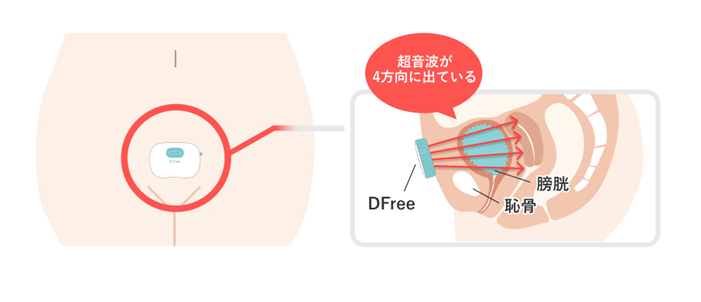
The DFree device, attached to the lower abdomen, measures bladder volume. Its cordless design minimizes discomfort for the wearer       Photo courtesy of DFree (Same below)

Until now, bladder monitoring was only possible with expensive medical scanners. DFree became Japan’s first wearable device to continuously track bladder status and give real-time alerts.

“The timing of notification differs for each person ー depending on the distance to the toilet, whether they need assistance, or whether they recognize the urge themselves,” says Nakanishi. “The biggest strength of DFree is its ability to set personalized thresholds.”
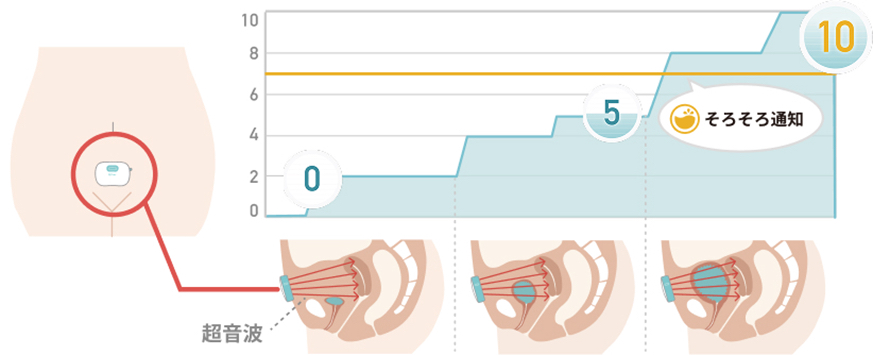
The device’s 10 notification levels guide users to the toilet with sound or vibration alerts tailored to each individual

To establish those thresholds, the device is worn for about two weeks to collect baseline data. Nurses and social workers then review the information ー along with the user’s living conditions and health ー to set the most suitable notification levels.
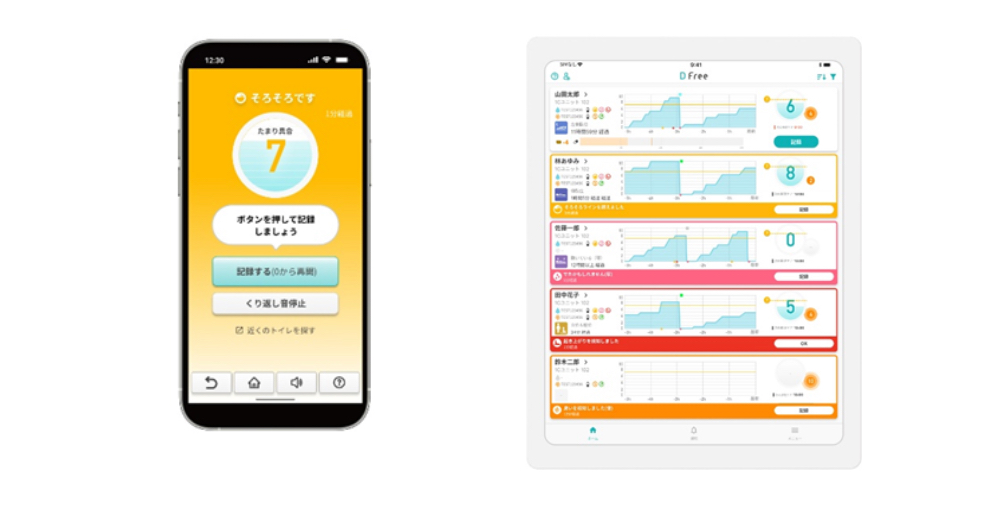
Left: The device’s notification level displayed on a smartphone for individual users. Right: Overview of notification levels as used in medical and nursing care facilities

Since April 2022, DFree has been covered under Japan’s Long-Term Care Insurance system, as a “specified welfare equipment” item, reducing the cost for users.

DFree is now in use at about 300 sites across Japan, including special nursing homes, geriatric health facilities, private care homes, and hospitals. It is also used in home care, and even as a support tool for toilet training among children with disabilities, including developmental disorders.

Feedback from facilities indicates that the device has improved the accuracy of caregiver prompts, cutting the number of guidance attempts by 1,110 per month and saving roughly 150 hours of staff time. One home-care user said: “My mother became withdrawn because of toilet accidents. Since starting to use DFree, the accidents have stopped, and she enjoys outings again. Most importantly, she’s smiling and talking with us.”

Nakanishi notes, “When toilet accidents reduce family conversations, it can affect cognitive function as well.”
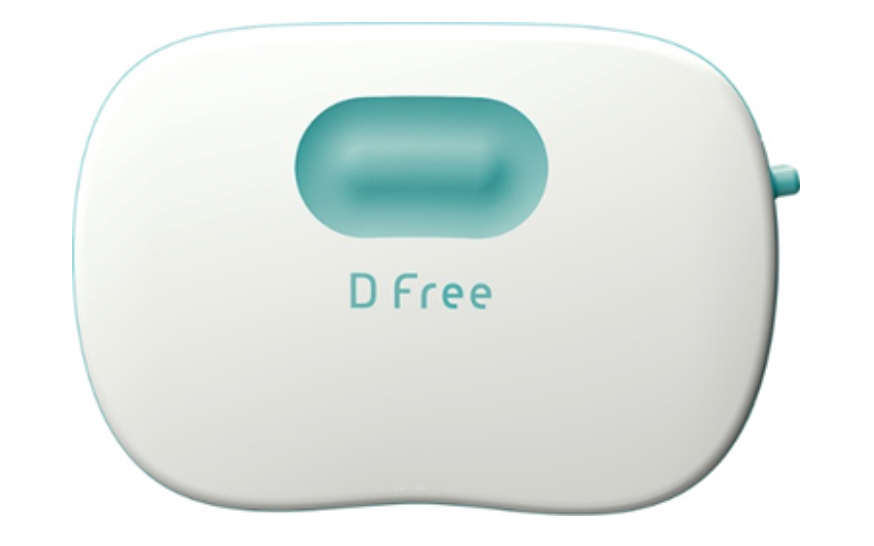
The first DFree devices weighed about 100 grams, but the latest version tips the scales at just 20 grams ー one-fifth of the original weight

The idea for DFree was born in 2013, when Nakanishi himself experienced incontinence while studying abroad in the United States. As he notes, urination and defecation are natural biological functions that don’t wait for the right time or place. “Preventing toilet accidents helps safeguard dignity, improve quality of life, and make better use of limited caregiving resources,” he says. “There are still challenges ー such as enabling measurement without a wearable device and predicting defecation as well as urination ー but we’ll keep working to help people remain independent for as long as possible.”
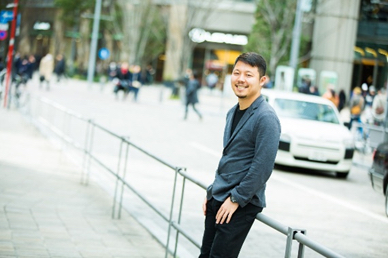
Atsushi Nakanishi, president and CEO of DFree. The company’s name reflects its mission: helping people stay “free from diapers.”

In January 2025, DFree formed a business alliance with Econavista, a Japanese company providing monitoring systems for elderly care based on sleep analysis. This partnership combines sleep and excretion data, supporting better rest, reducing fall risks, and easing caregiver workloads.

DFree is also moving toward system integration with Nemuri CONNECT, a monitoring support system for nursing and medical facilities developed by Paramount Bed. The Japanese company is a leader in hospital and elder-care beds and has also developed advanced technologies that allow staff to monitor residents’ sleep and safety without wearable devices. The integration is expected to be implemented within this fiscal year.

Looking ahead to next April, the company is preparing not only for domestic medical device certification but also for overseas expansion. That includes seeking approval from the U.S. Food and Drug Administration, a key step for entering the American market. “Aging is unavoidable, and healthcare is an issue that concerns everyone,” says Nakanishi. “We are targeting areas with large populations for sales, and will continue expanding into the U.S. and China.”

Translated by Anita De Michele | JStories

Edited by Mark Goldsmith

Top photo: Envato

For inquiries regarding this article, please contact jstories@pacificbridge.jp


Click here for the Japanese version of the article
Tags: Agetechaging population solutions JapanCaregivingelderly care technologyHealthTechInterviewJapanMedical InnovationStartupTokyo
Previous Post

Tokyo’s public baths: preserving tradition, welcoming the world

Next Post

Boston, not Silicon Valley, is Kansai’s model at Global Startup Expo 2025

Yoshiko Ohira

Yoshiko Ohira

Related Posts

Starting a sustainable wood-fired bakery in Tokyo
FoodTech

Starting a sustainable wood-fired bakery in Tokyo

by Tokyo Updates
03/05/2026
HealthTech

Engineering safety from the ground up

by Tokyo Updates
02/13/2026
Lifestyle

The plush toy hospital keeping childhood memories alive

by Tokyo Updates
01/30/2026
Social Impact

From a childhood shaped by conflict to an investor bridging Japan and the world

by Ayaka Sagasaki
01/23/2026
Lifestyle

Lost item return rate triples: Tokyo startup envisions a world where nothing stays lost

by Tokyo Updates
01/23/2026
Next Post

Boston, not Silicon Valley, is Kansai’s model at Global Startup Expo 2025

Leave a Reply Cancel reply

Your email address will not be published. Required fields are marked *

Videos

Taking action for peace

11/30/2022

Round-up Video #22

07/28/2022

Round-Up Video #38

12/15/2022

Browse by Tags

Ai Alternative Energy biotechnology Climate Change Community decarbonization Education Event Food foodtech Health Inclusion Infrastructure Innovation Interview J-Stories Japan Japan-Taiwan Innovation Summit Japan startups Japan Tech Labor Living Nature Podcast Recycling Refugees robotics Society Space Startup Startup Ecosystem Startups SusHI Tech Tokyo Sustainability Sustainable Society Taiwan Technology Tokyo Tokyo Innovation Base Tokyo Metropolitan Government Tokyo Updates venture capital video Wealth Zero Waste
JStories

©Articles and photos published on JSTORIES are protected by Japanese copyright law and international treaties. They cannot be reproduced without the permission of the copyright holders

Explore JStories

  • About Jstories
  • Company
  • Contact
  • Home
  • Partner Press Releases
  • Pricing
  • Privacy Policy
  • Team

Follow Us

Welcome Back!

Login to your account below

Forgotten Password?

Retrieve your password

Please enter your username or email address to reset your password.

Log In
No Result
View All Result
  • Home
  • AI
    • Artificial Intelligence
    • Robotics
    • Mobility
  • Earth
    • Energy
    • Climate Tech
    • AgriTech
    • Clean Tech
    • Disaster Tech
    • SpaceTech
  • Life Sciences
    • BioTech
    • HealthTech
    • MedTech
    • AgeTech
  • Society
    • Media
    • EdTech
    • Diversity
    • FemTech
    • HRTech
    • LegalTech
    • Social Impact
    • FinTech
    • Anime
  • Lifestyle
    • FoodTech
    • FashionTech
    • BeautyTech
    • Wellbeing
    • Art & Music
  • Travel
    • Adventure Travel
    • Luxury Travel
    • Wellness & Medical Tourism
    • Culture
  • Video
  • Deals
    • Venture Capital
    • M&A
    • Startup Events
    • Ecosystem Support
  • Interview
  • Opinion

©Articles and photos published on JSTORIES are protected by Japanese copyright law and international treaties. They cannot be reproduced without the permission of the copyright holders

Are you sure want to unlock this post?
Unlock left : 0
Are you sure want to cancel subscription?