

For AI startups, protecting intellectual property (IP) is critical to success, especially when expanding into the U.S. market. Many startups overlook the importance of a solid IP strategy, which can significantly impact their chances of success. In this essay, Eric D. Kirsch, a partner at Rimon, P.C., and an expert in intellectual property law, explores strategies for safeguarding AI innovations, focusing on patent acquisition and trade secret protection. He draws from his extensive experience in IP litigation and corporate counsel roles to highlight the risks of not having an IP strategy and the value of protecting AI innovations.
JSTORIES ー AI startups face many challenges during their journey from concept to successful business. Perhaps one of the most challenging areas for startups is how to leverage and protect their intellectual property. For many AI startups, developing an effective plan to protect their intellectual property is often neglected. No thought is given to developing an intellectual property strategy that protects their innovations for their particular use cases and their business model.
However, with many venture capital funds based in the United States, a U.S.-centric, well thought out IP strategy is imperative. Therefore, in this paper, I will explain some basic considerations for an AI startup’s IP strategy, particularly in the United States. AI startups need to understand that if they devote even a modest amount of effort to develop a plan to protect IP, their chances of success will dramatically improve.

One of the pitfalls of not having an IP strategy
First, many AI startups do not fully understand what a patent is. So, for those AI startups, please review Figure 1 (below) carefully. In Figure 1, Supreme AI, Inc. is an AI startup based in Tokyo but with a U.S. corporation formed in Delaware.
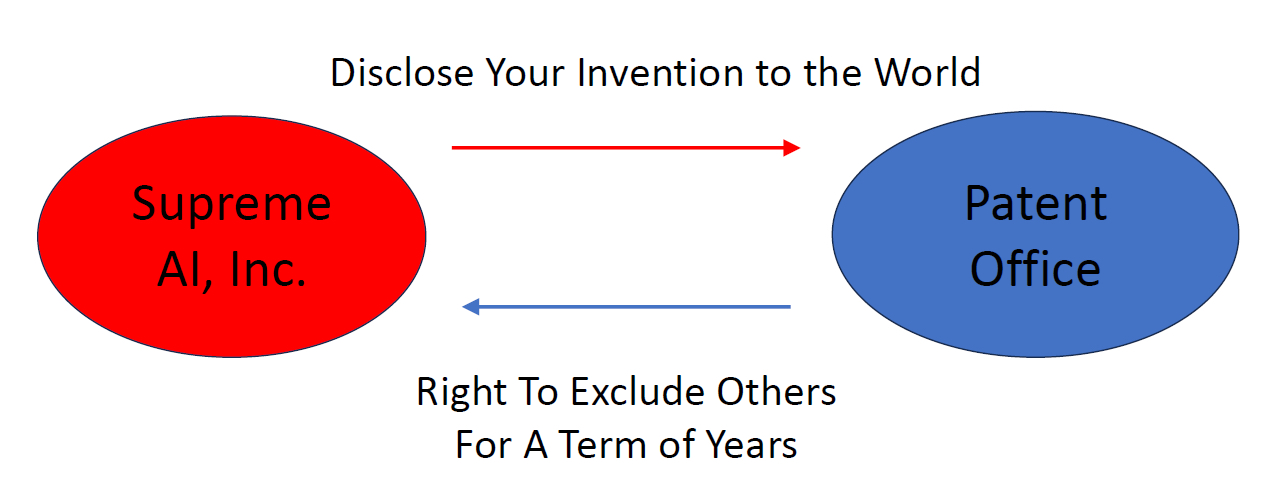
As shown in Figure 1, in order to obtain a patent, Supreme AI disclosed its idea to the Patent Office, whether that Patent Office is in Japan, America or some other country. And in 18 months without fail, Supreme AI’s patent application will be published so that anyone, including its competitors, can read about Supreme AI’s invention. At first, this may seem to be innocuous, however, that is not the case for several reasons.
First, the claim coverage for Supreme AI’s issued patent may be substantially narrower than what Supreme AI disclosed to the Patent Office. That difference between what Supreme AI disclosed to the Patent Office and what its patent claims cover is now dedicated to the public and therefore freely available for competitors to use.
Second, Supreme AI may not have sufficient funds to continue to prosecute the patent application or to continue to pay the maintenance fees to keep the patent in force. The effect of either of these scenarios is that Supreme AI disclosed its key invention to the world only to receive little or nothing in return. Therefore, Supreme AI’s key invention is now partially or wholly in the public domain, in other words, anyone including Supreme AI’s competitors can use it for free. Many AI startups do not fully appreciate this situation. Instead, they blindly file patent applications to check a box for their venture capital firm or seed investor, without understanding the potential downside of limited claim coverage or later abandoning their patent for lack of funds.
In sum, AI startups should carefully consider whether to disclose their core technology to the world in the form of a patent application.
The importance of trade secret protection for AI innovation

AI startups should understand that trade secret protection can also be used to protect their innovations. Although many people associate trade secrets with the formula for KFC or the formula for Listerine, trade secret protection works well for AI innovations, provided the innovation is not reverse-engineerable and cannot be duplicated independently by a competitor without too much effort.
The 3 main elements of a trade secret are: (1) secrecy (e.g., a secret formula, method or algorithm); (2) economic value or competitive advantage; and (3) procedures to maintain the trade secret. The pros and cons of Patent Protection versus Trade Secret Protection are summarized below in Figure 2. I highly recommend that AI startups carefully consider the pros and cons listed in Figure 2 before deciding on whether to use patents or trade secrets to protect their intellectual property.
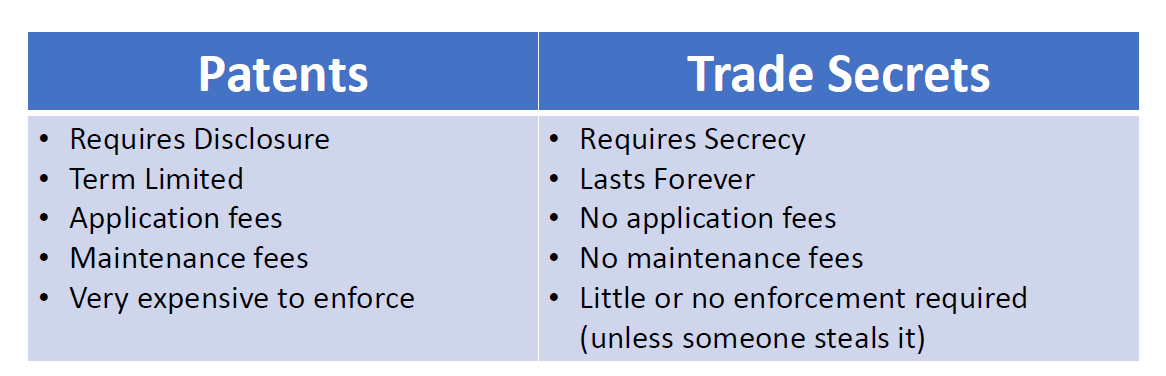
For AI innovations that are embedded in source code or the inner workings of a model, trade secret protection should be carefully considered. However, for chip level AI innovations that are not concealable, trade secret protection is not suitable. Instead, a moat of patent protection should be pursued. Therefore, one of the first and most important decisions an AI startup should make is whether to protect their core innovations with patents or as trade secrets. In other words, an AI startup should carefully consider the pros and cons listed in Figure 2 before deciding on how best to protect its intellectual property.
End of first part
In the second half, Eric will explain the differences between design patents and technology patents, as well as the requirements for patent eligibility in the United States.
About Eric D. Kirsch

Eric D. Kirsch is a partner with Rimon, P.C. and a permanent resident of Japan. Eric was a successful IP litigation partner in New York City before moving to Japan in 2010 to become Nikon’s Chief Intellectual Property Counsel. In 2023, Eric joined Rimon and opened Rimon’s Tokyo Office. If you have any questions about this article or a U.S. legal issue, Eric can be reached at eric.kirsch@rimonlaw.com
Top photo: Envato
For inquiries regarding this article, please contact jstories@pacificbridge.jp
Click here for the Japanese version of the article