• Login
Upgrade
JStories
  • 日本語
  • 中文 (中国)
No Result
View All Result
  • Home
  • AI
    • Artificial Intelligence
    • Robotics
    • Mobility
  • Earth
    • Energy
    • Climate Tech
    • AgriTech
    • Clean Tech
    • Disaster Tech
    • SpaceTech
  • Life Sciences
    • BioTech
    • HealthTech
    • MedTech
    • AgeTech
  • Society
    • Media
    • EdTech
    • Diversity
    • FemTech
    • HRTech
    • LegalTech
    • Social Impact
    • FinTech
    • Anime
  • Lifestyle
    • FoodTech
    • FashionTech
    • BeautyTech
    • Wellbeing
    • Art & Music
  • Travel
    • Adventure Travel
    • Luxury Travel
    • Wellness & Medical Tourism
    • Culture
  • Video
  • Deals
    • Venture Capital
    • M&A
    • Startup Events
    • Pitch
    • Ecosystem Support
  • Interview
  • Opinion
  • Home
  • AI
    • Artificial Intelligence
    • Robotics
    • Mobility
  • Earth
    • Energy
    • Climate Tech
    • AgriTech
    • Clean Tech
    • Disaster Tech
    • SpaceTech
  • Life Sciences
    • BioTech
    • HealthTech
    • MedTech
    • AgeTech
  • Society
    • Media
    • EdTech
    • Diversity
    • FemTech
    • HRTech
    • LegalTech
    • Social Impact
    • FinTech
    • Anime
  • Lifestyle
    • FoodTech
    • FashionTech
    • BeautyTech
    • Wellbeing
    • Art & Music
  • Travel
    • Adventure Travel
    • Luxury Travel
    • Wellness & Medical Tourism
    • Culture
  • Video
  • Deals
    • Venture Capital
    • M&A
    • Startup Events
    • Pitch
    • Ecosystem Support
  • Interview
  • Opinion
en English ja 日本語 zh 中文 (中国)
JStories
No Result
View All Result

Turning bone china into fertilizer

Yui Sawada by Yui Sawada
06/17/2022
in AgriTech, Clean Tech, Earth, FoodTech, Lifestyle
0
Home Earth AgriTech
Share on FacebookShare on Twitter

J-STORIES – Bone china is admired for its creamy white color and luminous, translucent sheen. Although known as the strongest porcelain or china ware, bone china can break, and when it does it is often thrown away. Now, a Japanese tableware manufacturer with a history stretching back over a century has found a new way to recycle old ceramics.

Bone china gets its name from the cow bone ash used in its manufacture, a substance rich in tricalcium phosphate, which is commonly used as a fertilizer. The company, Nikko, which was founded in 1908, has developed a way to turn discarded china into fertilizer. In February, the porcelain-derived fertilizer was certified for use by Japan’s Ministry of Agriculture, Forestry and Fisheries.

Nikko’s initiative could solve two problems.

First, Japan does not mine any phosphate, so imports it from China and elsewhere. This makes the country’s agriculture vulnerable to fertilizer price hikes. Second, long before the coronavirus pandemic reduced demand from the restaurant sector, Japanese tableware manufacturers were already facing fierce competition from low-priced imports.

Noriko Kobayashi, a marketing manager at Nikko, told J-Stories that the company is seeking ways to stay in business for another 100 years, while  fulfilling the environmental commitments of its corporate philosophy.

However, it may be difficult for Nikko to expand the initiative overseas as the legal standards for fertilizer vary from country to country, explained Mikio Takimoto, who leads the company’s R&D division.

“But even if it’s hard to make fertilizer to meet each country’s standards, we’d like to work with various partners to expand this project,” said Takimoto.
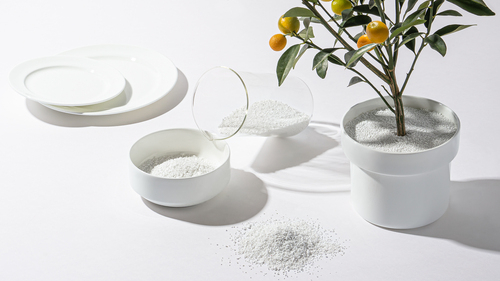
The fertilizer is a white powder that can be used to decorate soil as well as enrich it.      Source: Nikko

For now, the company is recycling tableware that fails its production quality control tests, but it is also looking at recovering old tableware from restaurants and hotels. Such discarded ceramics are not only those made by Nikko itself, but potentially other companies, too.
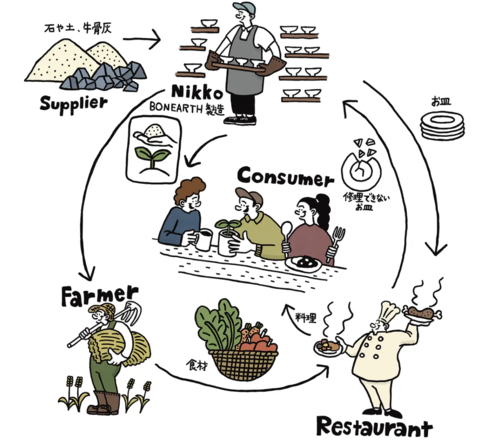
Nikko is currently recycling ceramics that fail its quality control tests, but also plans to use old tableware from restaurants.      Source: Nikko

Nikko’s own tableware is particularly rich in tricalcium phosphate, containing 50% of the substance versus the 30% legal minimum that is set for Japanese porcelain. Indeed, it was this higher content that inspired the company’s fertilizer project.

In addition to fertilizer production, however, the recycled tricalcium phosphate could be used to make new bone china tableware. That means old restaurant tableware could be used to make their replacements, or as fertilizer to grow vegetables that are served in the restaurant.

It’s a deliciously ingenious example of circular recycling that links farmer, diner and tableware manufacturer.

Translation and Editing by Tony McNicol

Top page photo by Nikko

For inquires about this article, please contact us at jstories@pacificbridge.jp


Click here for the Japanese version of the article.
Tags: EarthRecycling
Previous Post

Round-up Video #16

Next Post

A ‘zero waste’ town deep in the Japanese mountains

Yui Sawada

Yui Sawada

Related Posts

Starting a sustainable wood-fired bakery in Tokyo
FoodTech

Starting a sustainable wood-fired bakery in Tokyo

by Tokyo Updates
03/05/2026
Clean Tech

Japanese startup turns eggshell waste into eco-friendly plastics and paper

by Yoshiko Ohira
02/06/2026
Earth

A world first: Detecting road sinkholes from space

by Ayaka Sagasaki
01/30/2026
Lifestyle

The plush toy hospital keeping childhood memories alive

by Tokyo Updates
01/30/2026
Lifestyle

Lost item return rate triples: Tokyo startup envisions a world where nothing stays lost

by Tokyo Updates
01/23/2026
Next Post

A 'zero waste' town deep in the Japanese mountains

Leave a Reply Cancel reply

Your email address will not be published. Required fields are marked *

Videos

Round-up Video #27

09/22/2022

Round-Up Video #30

10/13/2022

Round-Up Video #38

12/15/2022

Browse by Tags

Ai Alternative Energy biotechnology Climate Change Community decarbonization Education Event Food foodtech Health Inclusion Infrastructure Innovation Interview J-Stories Japan Japan-Taiwan Innovation Summit Japan startups Japan Tech Labor Living Nature Podcast Recycling Refugees robotics Society Space Startup Startup Ecosystem Startups SusHI Tech Tokyo Sustainability Sustainable Society Taiwan Technology Tokyo Tokyo Innovation Base Tokyo Metropolitan Government Tokyo Updates venture capital video Wealth Zero Waste
JStories

©Articles and photos published on JSTORIES are protected by Japanese copyright law and international treaties. They cannot be reproduced without the permission of the copyright holders

Explore JStories

  • About Jstories
  • Company
  • Contact
  • Home
  • Partner Press Releases
  • Pricing
  • Privacy Policy
  • Team

Follow Us

Welcome Back!

Login to your account below

Forgotten Password?

Retrieve your password

Please enter your username or email address to reset your password.

Log In
No Result
View All Result
  • Home
  • AI
    • Artificial Intelligence
    • Robotics
    • Mobility
  • Earth
    • Energy
    • Climate Tech
    • AgriTech
    • Clean Tech
    • Disaster Tech
    • SpaceTech
  • Life Sciences
    • BioTech
    • HealthTech
    • MedTech
    • AgeTech
  • Society
    • Media
    • EdTech
    • Diversity
    • FemTech
    • HRTech
    • LegalTech
    • Social Impact
    • FinTech
    • Anime
  • Lifestyle
    • FoodTech
    • FashionTech
    • BeautyTech
    • Wellbeing
    • Art & Music
  • Travel
    • Adventure Travel
    • Luxury Travel
    • Wellness & Medical Tourism
    • Culture
  • Video
  • Deals
    • Venture Capital
    • M&A
    • Startup Events
    • Ecosystem Support
  • Interview
  • Opinion

©Articles and photos published on JSTORIES are protected by Japanese copyright law and international treaties. They cannot be reproduced without the permission of the copyright holders

Are you sure want to unlock this post?
Unlock left : 0
Are you sure want to cancel subscription?