• Login
Upgrade
JStories
  • 日本語
  • 中文 (中国)
No Result
View All Result
  • Home
  • AI
    • Artificial Intelligence
    • Robotics
    • Mobility
  • Earth
    • Energy
    • Climate Tech
    • AgriTech
    • Clean Tech
    • Disaster Tech
    • SpaceTech
  • Life Sciences
    • BioTech
    • HealthTech
    • MedTech
    • AgeTech
  • Society
    • Media
    • EdTech
    • Diversity
    • FemTech
    • HRTech
    • LegalTech
    • Social Impact
    • FinTech
    • Anime
  • Lifestyle
    • FoodTech
    • FashionTech
    • BeautyTech
    • Wellbeing
    • Art & Music
  • Travel
    • Adventure Travel
    • Luxury Travel
    • Wellness & Medical Tourism
    • Culture
  • Video
  • Deals
    • Venture Capital
    • M&A
    • Startup Events
    • Pitch
    • Ecosystem Support
  • Interview
  • Opinion
  • Home
  • AI
    • Artificial Intelligence
    • Robotics
    • Mobility
  • Earth
    • Energy
    • Climate Tech
    • AgriTech
    • Clean Tech
    • Disaster Tech
    • SpaceTech
  • Life Sciences
    • BioTech
    • HealthTech
    • MedTech
    • AgeTech
  • Society
    • Media
    • EdTech
    • Diversity
    • FemTech
    • HRTech
    • LegalTech
    • Social Impact
    • FinTech
    • Anime
  • Lifestyle
    • FoodTech
    • FashionTech
    • BeautyTech
    • Wellbeing
    • Art & Music
  • Travel
    • Adventure Travel
    • Luxury Travel
    • Wellness & Medical Tourism
    • Culture
  • Video
  • Deals
    • Venture Capital
    • M&A
    • Startup Events
    • Pitch
    • Ecosystem Support
  • Interview
  • Opinion
en English ja 日本語 zh 中文 (中国)
JStories
No Result
View All Result

Wearable robot helps patients with mobility problems walk again

Alisa Okawara by Alisa Okawara
10/27/2023
in AgeTech, BioTech, HealthTech, Life Sciences, MedTech
0
Home Life Sciences AgeTech
Share on FacebookShare on Twitter

sJ-STORIES – Imagine a cybernetic world like the Japanese cyberpunk franchise, “Ghost in the Shell”, where spinal cord injuries heal quickly, or where people can regain leg function after a car crash. It seems far-fetched, but one Japanese company is working to bring this fantasy world closer to reality.

Since it started out almost two decades ago, tech company Cyberdyne has been working on a new scientific field called “cybernics”. Coined by company CEO Yoshiyuki Sankai, cybernics is an amalgamation of various scientific disciplines such as neuroscience, artificial intelligence and robotics, and the corresponding industries, technologies and therapies.

The company pioneered the wearable exoskeleton robot known as ‘HAL’ (Hybrid Assistive Limb) that incorporates cybernics to assist the mobility of people whose muscle functionality has somehow become impaired. By detecting signals sent from the brain to the muscles, HAL moves according to the user’s intention. The repetition of this process allows the brain to learn how to send signals that will result in precise and intended movements.
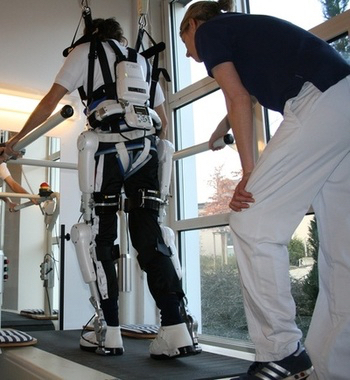
HAL in use at a rehabilitation facility in California.     Source: Cyberdyne

HAL is used in over 20 countries and has recorded a variety of successes. It is commonly used in assisting the treatment of various diseases and injuries that affect muscular function, such as neuromuscular conditions and spinal cord injuries. Last year, the academic journal Internal Medicine reported that patients with Amyotrophic Lateral Sclerosis (ALS), a neurological disorder that affects motor neurons and subsequently weakens muscles, managed to improve their gait significantly.

Also, HAL has been effective with injuries sustained from car accidents. Sankai presented a case this year where a middle-aged woman, who was unable to use her right leg for five years due to a car crash, was able to resume daily life and start jogging again after just three months of treatment.

HAL went viral in February of this year when legendary British rock singer Ozzy Osbourne posted on social media platforms about receiving treatment for his spine damage.

https://www.instagram.com/p/CoHFEa1O6Lv/

Cyberdyne’s Sankai told J-stories it is vital to break down what he considers ‘artificial barriers’ between science and technology. However, the difficulty lies in the need to create an infrastructure that can bring the various technologies together. Since 2018,  the company has been providing technical mentorship to startups and entrepreneurs who are working in a range of scientific fields to solve social problems through a project known as C-startup.

In addition, the Cybernics Excellence Japan (CEJ) fund, which includes Cyberdyne, as well as prominent financial institutions and life insurance companies in Japan, managed to raise ¥10 billion. Close to 30 startup companies, from bio and drug research, regenerative medicine, to apparel have been funded. The CEJ Fund has worked to initiate progress that can lead to the creation of a “Society 5.0/5.1,” which is touted as a “techno-peer support society where humans and technologies support one another.”

One of the companies funded by the CEJ includes Xenoma, a  a company with clothing technology that can record body movement and electrocardiogram measurements.Through this, they are aiming for a “streamlined promotion of innovative technologies and devices from R&D (research and development) to social implementation” on a global scale.
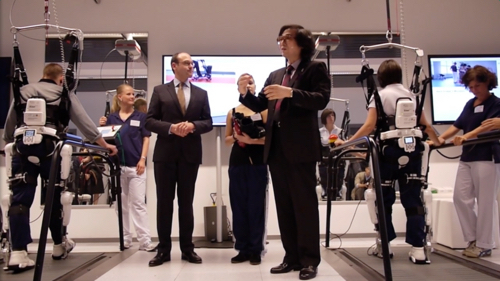
Cyberdyne CEO Sankai giving a talk on HAL in Germany.     Source: Cyberdyne

Apart from funding, Cyberdyne has strengthened its partnership with Hirosaki Lifescience Innovation, a company working on regenerative medicine products based on blood vessel technology. The two companies have worked on the Cybernics Medical Innovation Base-A research facility, which was built close to Haneda Airport in February last year.

Another similar facility, the National Center for Neuro-robotics and Cybernetics, is being built in Malaysia and is expected to be the biggest medical complex in Southeast Asia upon its completion in 2024.

An image of the National Center for Neuro-robotics and Cybernetics being built in Malaysia.     Source: Cyberdyne

Cyberdyne has announced the creation of a smaller version of the HAL device in June, which can be used by people under 150 cm in height and between 15 kg and 50 kg in weight. Though it still needs governmental clearance in Japan, Sankai hopes that one day it can be used globally, as he believes technology must help create a society that includes and looks after everyone.

“There must not be a situation where people left behind in the advancement of science and technology, such as the elderly and vulnerable people with incurable diseases, are locked up in a room somewhere,” he said. “The challenge for us now is to analyze how it can be used effectively, taking into account the degree of disease and individual differences,”.
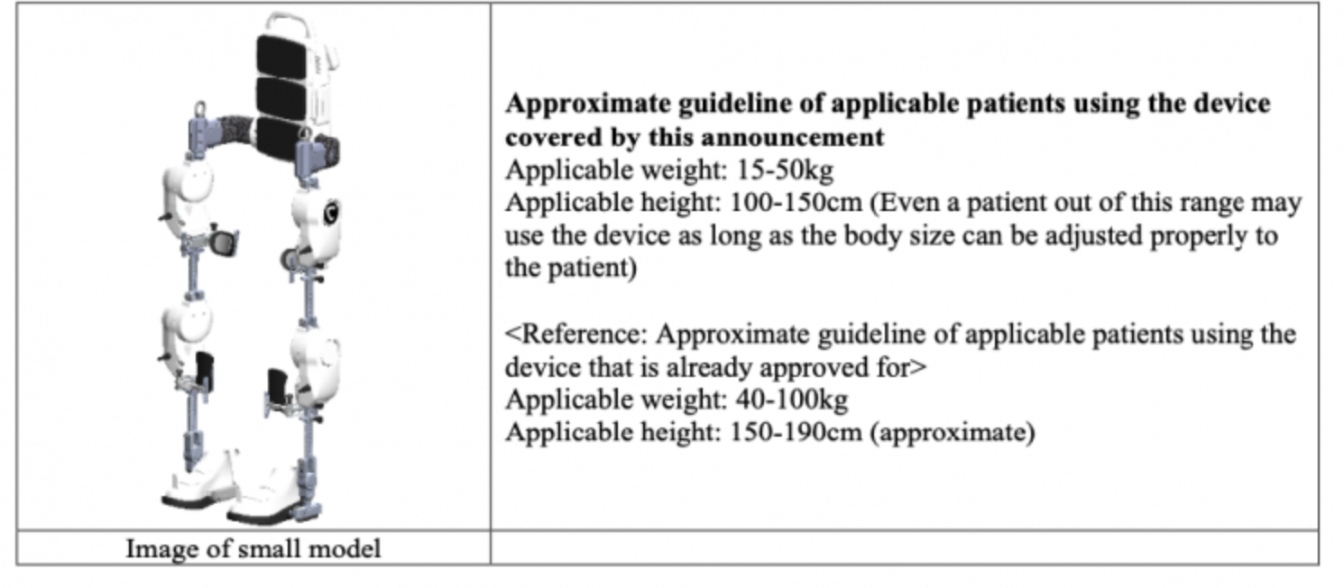
An image of the smaller HAL device.     Source: Cyberdyne

Writing by Alisa Okawara

Editing by Desiderio Luna

Top page photo by Cyberdyne

For inquiries about this article, please contact jstories@pacficbridge.jp


Click here for the Japanese version of the article.
Tags: cyberneticsexoskeletonInterviewJapanrobotics
Previous Post

Endo Manufacturing forges ahead in Japan’s golf world and beyond

Next Post

Wooden satellites touted as an eco-friendly alternative to polluting aluminum

Alisa Okawara

Alisa Okawara

Related Posts

HealthTech

Engineering safety from the ground up

by Tokyo Updates
02/13/2026
BioTech

Toward a targeted therapy with fewer side effects for chronic allergic eye disease

by Yoshiko Ohira
01/08/2026
BioTech

Toward a future where cancer is treated like a common cold

by Kei Mizuno
11/12/2025
Diversity

Innovative infant-care product presented at SusHi Tech Tokyo 2025

by Tokyo Updates
10/03/2025
Deals

Boston, not Silicon Valley, is Kansai’s model at Global Startup Expo 2025

by Nithin Coca
09/27/2025
Next Post

Wooden satellites touted as an eco-friendly alternative to polluting aluminum

Leave a Reply Cancel reply

Your email address will not be published. Required fields are marked *

Videos

Taking action for peace

11/30/2022

Round-up Video #25

09/01/2022

Round-up Video #21

07/21/2022

Browse by Tags

Ai Alternative Energy biotechnology Climate Change Community decarbonization Education Event Food foodtech Health Inclusion Infrastructure Innovation Interview J-Stories Japan Japan-Taiwan Innovation Summit Japan startups Japan Tech Labor Living Nature Podcast Recycling Refugees robotics Society Space Startup Startup Ecosystem Startups SusHI Tech Tokyo Sustainability Sustainable Society Taiwan Technology Tokyo Tokyo Innovation Base Tokyo Metropolitan Government Tokyo Updates venture capital video Wealth Zero Waste
JStories

©Articles and photos published on JSTORIES are protected by Japanese copyright law and international treaties. They cannot be reproduced without the permission of the copyright holders

Explore JStories

  • About Jstories
  • Company
  • Contact
  • Home
  • Partner Press Releases
  • Pricing
  • Privacy Policy
  • Team

Follow Us

Welcome Back!

Login to your account below

Forgotten Password?

Retrieve your password

Please enter your username or email address to reset your password.

Log In
No Result
View All Result
  • Home
  • AI
    • Artificial Intelligence
    • Robotics
    • Mobility
  • Earth
    • Energy
    • Climate Tech
    • AgriTech
    • Clean Tech
    • Disaster Tech
    • SpaceTech
  • Life Sciences
    • BioTech
    • HealthTech
    • MedTech
    • AgeTech
  • Society
    • Media
    • EdTech
    • Diversity
    • FemTech
    • HRTech
    • LegalTech
    • Social Impact
    • FinTech
    • Anime
  • Lifestyle
    • FoodTech
    • FashionTech
    • BeautyTech
    • Wellbeing
    • Art & Music
  • Travel
    • Adventure Travel
    • Luxury Travel
    • Wellness & Medical Tourism
    • Culture
  • Video
  • Deals
    • Venture Capital
    • M&A
    • Startup Events
    • Ecosystem Support
  • Interview
  • Opinion

©Articles and photos published on JSTORIES are protected by Japanese copyright law and international treaties. They cannot be reproduced without the permission of the copyright holders

Are you sure want to unlock this post?
Unlock left : 0
Are you sure want to cancel subscription?