• Login
Upgrade
JStories
  • 日本語
  • 中文 (中国)
No Result
View All Result
  • Home
  • AI
    • Artificial Intelligence
    • Robotics
    • Mobility
  • Earth
    • Energy
    • Climate Tech
    • AgriTech
    • Clean Tech
    • Disaster Tech
    • SpaceTech
  • Life Sciences
    • BioTech
    • HealthTech
    • MedTech
    • AgeTech
  • Society
    • Media
    • EdTech
    • Diversity
    • FemTech
    • HRTech
    • LegalTech
    • Social Impact
    • FinTech
    • Anime
  • Lifestyle
    • FoodTech
    • FashionTech
    • BeautyTech
    • Wellbeing
    • Art & Music
  • Travel
    • Adventure Travel
    • Luxury Travel
    • Wellness & Medical Tourism
    • Culture
  • Video
  • Deals
    • Venture Capital
    • M&A
    • Startup Events
    • Pitch
    • Ecosystem Support
  • Interview
  • Opinion
  • Home
  • AI
    • Artificial Intelligence
    • Robotics
    • Mobility
  • Earth
    • Energy
    • Climate Tech
    • AgriTech
    • Clean Tech
    • Disaster Tech
    • SpaceTech
  • Life Sciences
    • BioTech
    • HealthTech
    • MedTech
    • AgeTech
  • Society
    • Media
    • EdTech
    • Diversity
    • FemTech
    • HRTech
    • LegalTech
    • Social Impact
    • FinTech
    • Anime
  • Lifestyle
    • FoodTech
    • FashionTech
    • BeautyTech
    • Wellbeing
    • Art & Music
  • Travel
    • Adventure Travel
    • Luxury Travel
    • Wellness & Medical Tourism
    • Culture
  • Video
  • Deals
    • Venture Capital
    • M&A
    • Startup Events
    • Pitch
    • Ecosystem Support
  • Interview
  • Opinion
en English ja 日本語 zh 中文 (中国)
JStories
No Result
View All Result

Saving the northern white rhino

Ayaka Sagasaki by Ayaka Sagasaki
03/01/2023
in Earth, Social Impact, Society
0
Home Earth
Share on FacebookShare on Twitter

J-STORIES – Scientists at a Japanese university have successfully used stem cells to generate the precursors of eggs of one of the globe’s most threatened species.

Led by Katsuhiko Hayashi, a professor at Osaka University’s faculty of medicine who is well known for his stem cell research, the team succeeded in generating germ cells, the precursors of eggs, from induced pluripotent stem (iPS) cells of the northern white rhino, of which there are only two in the world.

The northern white rhino is extinct in the wild, and despite a decades-long effort to preserve the species through a breeding program only two remain in captivity. However, Najin and Fatu, who live at the Ol Pejeta conservation park in Kenya, are both female, the last bull of their species having died in 2018.

Determined to ensure that they won’t be the last of their kind, Hayashi and his team developed the stem cell technique in the hope that if these immature reproductive germ cells successfully develop into eggs, they could be used in in vitro fertilization with frozen sperm from deceased bulls to produce new rhino calves.

Although mouse and human germ cells have been produced before, this is the first time the technique has been successfully used in wild animals. Not only is it more difficult to generate wild animal germ cells and eggs, but collecting the stem cells themselves is complicated, and the practical challenges are different for each species.

But Hayashi believes that if such obstacles can be overcome, it might be possible to breed and save not just the endangered rhino, but also other animals facing extinction.
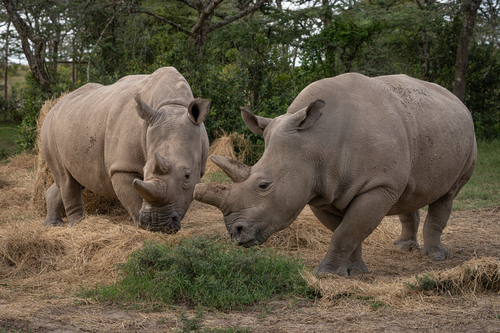
Najin and Fatu are the last two remaining northern white rhinos.     Source: Osaka University

Research has shown that cells from the skin, or blood can be reprogrammed back into an embryonic-like state and Hayashi’s method is based on skin cells saved from deceased rhinos, potentially opening a window for a greater source of eggs than was previously available.

This has attracted global attention, leading to Hayashi’s participation in BioRescue, an international research project involving scientists from Germany, Italy, the Czech Republic, and Japan. Led by Thomas Bernd Hildebrandt, a professor at the Leibniz Institute for Zoo and Wildlife Research in Germany, the group aims to preserve and increase populations of critically endangered species, in particular the northern white rhino.

The group has already recovered immature egg cells (oocytes) from the two last northern white rhinos and fertilized them with sperm to produce embryos. They plan to implant these in a surrogate mother from a closely related species, the southern white rhinoceros, to give birth to northern white rhinoceros calves.

Nonetheless, experts say there are still hurdles to address, including whether or not those surrogates can successfully carry the embryos to produce northern white rhino offspring. Another challenge is ensuring the genetic diversity that is necessary to sustain a population, without which the undesirable consequences of inbreeding can result.

There have also been calls to reflect and act on why this species, and indeed all six species of rhinoceros living in Asia and Africa, have been placed at risk of extinction. A main reason is that in countries such as China and Vietnam, rhino horns are highly sought after as a traditional remedy for a variety of ailments, and consequently command extremely high prices. Despite the best efforts of rangers, rhinos are still being hunted by poachers.

“We want to use our technology to save endangered species,” says Hayashi, who in 2016 led a group that transformed mouse skin cells into eggs in a dish — the first-ever creation of eggs entirely outside a mouse. “In particular, I feel it is our human duty to save the northern white rhino, which is being driven to extinction at the hands of humans.”

Translation by Tony McNicol

Top page photo by Osaka University

For inquiries about this article, please contact us at jstories@pacificbridge.jp


Click here for the Japanese version of the article.

Tags: EnvironmentNatureTechnologyWild Life
Previous Post

Round-Up #46

Next Post

Perfect e-fit

Ayaka Sagasaki

Ayaka Sagasaki

Related Posts

Japan leads global collaboration to combat AI disinformation
AI

Japan leads global collaboration to combat AI disinformation

by Ayaka Sagasaki
03/16/2026
Clean Tech

Japanese startup turns eggshell waste into eco-friendly plastics and paper

by Yoshiko Ohira
02/06/2026
Anime

World-first “anime character-based therapy” trial to test effectiveness in Japanese young adults

by Lucas Maltzman
01/30/2026
Earth

A world first: Detecting road sinkholes from space

by Ayaka Sagasaki
01/30/2026
Social Impact

From a childhood shaped by conflict to an investor bridging Japan and the world

by Ayaka Sagasaki
01/23/2026
Next Post

Perfect e-fit

Leave a Reply Cancel reply

Your email address will not be published. Required fields are marked *

Videos

Harmonizing tradition and technology with immersive sound experience

07/19/2023

Round-up Video #13

05/26/2022

Round-up Video #23

08/04/2022

Browse by Tags

Ai Alternative Energy biotechnology Climate Change Community decarbonization Education Event Food foodtech Health Inclusion Infrastructure Innovation Interview J-Stories Japan Japan-Taiwan Innovation Summit Japan startups Japan Tech Labor Living Nature Podcast Recycling Refugees robotics Society Space Startup Startup Ecosystem Startups SusHI Tech Tokyo Sustainability Sustainable Society Taiwan Technology Tokyo Tokyo Innovation Base Tokyo Metropolitan Government Tokyo Updates venture capital video Wealth Zero Waste
JStories

©Articles and photos published on JSTORIES are protected by Japanese copyright law and international treaties. They cannot be reproduced without the permission of the copyright holders

Explore JStories

  • About Jstories
  • Company
  • Contact
  • Home
  • Partner Press Releases
  • Pricing
  • Privacy Policy
  • Team

Follow Us

Welcome Back!

Login to your account below

Forgotten Password?

Retrieve your password

Please enter your username or email address to reset your password.

Log In
No Result
View All Result
  • Home
  • AI
    • Artificial Intelligence
    • Robotics
    • Mobility
  • Earth
    • Energy
    • Climate Tech
    • AgriTech
    • Clean Tech
    • Disaster Tech
    • SpaceTech
  • Life Sciences
    • BioTech
    • HealthTech
    • MedTech
    • AgeTech
  • Society
    • Media
    • EdTech
    • Diversity
    • FemTech
    • HRTech
    • LegalTech
    • Social Impact
    • FinTech
    • Anime
  • Lifestyle
    • FoodTech
    • FashionTech
    • BeautyTech
    • Wellbeing
    • Art & Music
  • Travel
    • Adventure Travel
    • Luxury Travel
    • Wellness & Medical Tourism
    • Culture
  • Video
  • Deals
    • Venture Capital
    • M&A
    • Startup Events
    • Ecosystem Support
  • Interview
  • Opinion

©Articles and photos published on JSTORIES are protected by Japanese copyright law and international treaties. They cannot be reproduced without the permission of the copyright holders

Are you sure want to unlock this post?
Unlock left : 0
Are you sure want to cancel subscription?