• Login
Upgrade
JStories
  • 日本語
  • 中文 (中国)
No Result
View All Result
  • Home
  • AI
    • Artificial Intelligence
    • Robotics
    • Mobility
  • Earth
    • Energy
    • Climate Tech
    • AgriTech
    • Clean Tech
    • Disaster Tech
    • SpaceTech
  • Life Sciences
    • BioTech
    • HealthTech
    • MedTech
    • AgeTech
  • Society
    • Media
    • EdTech
    • Diversity
    • FemTech
    • HRTech
    • LegalTech
    • Social Impact
    • FinTech
    • Anime
  • Lifestyle
    • FoodTech
    • FashionTech
    • BeautyTech
    • Wellbeing
    • Art & Music
  • Travel
    • Adventure Travel
    • Luxury Travel
    • Wellness & Medical Tourism
    • Culture
  • Video
  • Deals
    • Venture Capital
    • M&A
    • Startup Events
    • Pitch
    • Ecosystem Support
  • Interview
  • Opinion
  • Home
  • AI
    • Artificial Intelligence
    • Robotics
    • Mobility
  • Earth
    • Energy
    • Climate Tech
    • AgriTech
    • Clean Tech
    • Disaster Tech
    • SpaceTech
  • Life Sciences
    • BioTech
    • HealthTech
    • MedTech
    • AgeTech
  • Society
    • Media
    • EdTech
    • Diversity
    • FemTech
    • HRTech
    • LegalTech
    • Social Impact
    • FinTech
    • Anime
  • Lifestyle
    • FoodTech
    • FashionTech
    • BeautyTech
    • Wellbeing
    • Art & Music
  • Travel
    • Adventure Travel
    • Luxury Travel
    • Wellness & Medical Tourism
    • Culture
  • Video
  • Deals
    • Venture Capital
    • M&A
    • Startup Events
    • Pitch
    • Ecosystem Support
  • Interview
  • Opinion
en English ja 日本語 zh 中文 (中国)
JStories
No Result
View All Result

Driver assistance system mimics eye

Ayaka Sagasaki by Ayaka Sagasaki
01/25/2023
in Mobility
0
Home AI Mobility
Share on FacebookShare on Twitter

J-STORIES – A new driver assistance system that mimics the flexible vision of the human eye is bringing fully autonomous driving even closer. This system can detect and analyze key objects in a car’s environment, such as traffic lights, cars and pedestrians. It can even “see” objects clearly when visibility is poor, such as during misty weather conditions.

Stera Vision, a company based in Tsukuba, a city northeast of Tokyo, has developed a compact, low-cost “LiDAR” technology that is at the cutting edge of so-called Advanced driver-assistance systems (ADAS).

ADAS with functions such as automatic braking and lane centering typically rely on cameras and millimeter-wave radar. However, LiDAR (light detection and ranging) technology, which works by shining light on an object to calculate its location, is considered essential for fully autonomous driving.

There are six levels of vehicle autonomy. While driver assistance is required at levels 0, 1 and 2, levels above that feature automated systems that monitor the driving environment. There is fierce competition to develop level 4 systems, which enable driving without any human intervention under specific circumstances. There are autonomous taxi services already in operation in the United States and China, while in Japan, a level 4 system is expected to start in April.

The ultimate goal is level 5 technology, such as that being developed by Stera Vision, which automates all driving tasks under all conditions.

A key feature is how the company’s LiDAR system mimics human vision. The human eye does not see everything in the field of vision equally. Rather, it picks up things it wants or needs to see and looks at those in more detail. That’s why, even though we can’t move our eyeballs at high speed, we can still select necessary visual information, process it, and make rapid decisions.

In order to mimic this capacity of the human eye to see objects in the detail required for safe automated driving, Stera Vision developed a “Multipol” scanner. If there is a crossing several hundred meters ahead, for example, the device can prioritize that area to scan and analyze it. On the other hand, it will scan the sky and other areas irrelevant to safe driving at a much lower level of detail.
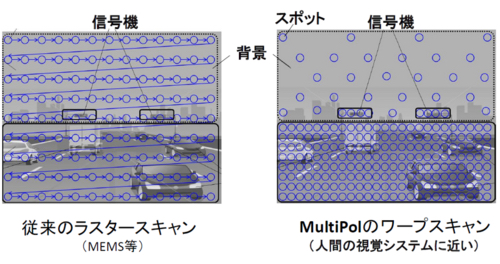
In the image on the right, the MultiPol system scans the road and traffic signals more often than the sky.     Source: Stera Vision

“In the same way as the human eye, the system is capable of flexible scanning,” said Stera Vision CEO Hisato Uetsuka. This process of selection allows a scanning frame rate  for important objects in the field of vision that is more than 10 times faster than other systems.

Meanwhile, the company has also developed a high performance laser that makes use of Frequency Modulated Continuous Wave (FMCW) radar. FMCW works by continuously emitting laser light of varying frequency to measure the distance to objects.
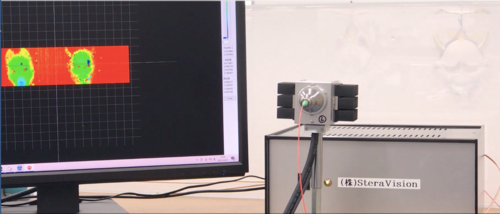
Stera Vision’s LiDAR system is able to clearly recognize a Japanese Noh theater mask behind mist.     Source: Stera Vision

“Our LiDAR system combines these technologies and is the only one of its kind in the world,” Uetsuka told J-Stories. “It also has the advantage of being relatively cheap to install. We would like to continue its development with the aim of achieving and popularizing autonomous driving.”

Last year, Stera Vision started shipping LiDAR systems for testing and is getting an increasing number of inquiries from Japan and abroad. The system can also measure the direction and depth of cracks in roads, so could be used for construction and agricultural machinery in addition to passenger vehicles. Other possible new uses include fitting it to drones in order to better inspect infrastructure, such as dams, electricity pylons and transmission towers.

Translation by Tony McNicol

Top page photo by Stera Vision

For inquiries about this article, please contact jstories@pacficbridge.jp


Click here for the Japanese version of the article.

Tags: LivingSocietyTechnology
Previous Post

Round-Up Video #41

Next Post

Wireless communication below the waves

Ayaka Sagasaki

Ayaka Sagasaki

Related Posts

AI

Japan-Luxembourg startup bets on AC battery breakthrough for EVs — and beyond

by Nithin Coca
09/03/2025
AI

Largest Japan-Taiwan startup events wrap up in Osaka, Tokyo

by J-STORIES
09/03/2025
AI

Taiwanese startups eye Osaka and Kansai, linking with the Osaka-Kansai Expo

by J-STORIES
08/20/2025
AI

Japan’s NTT uses drone to capture and redirect lightning strikes in world first

by Ayaka Sagasaki
08/07/2025
AI

Tech from Taiwan takes the stage in Osaka this August

by J-STORIES
08/01/2025
Next Post

Wireless communication below the waves

Leave a Reply Cancel reply

Your email address will not be published. Required fields are marked *

Videos

Round-up Video #23

08/04/2022

Round-Up Video #32

11/03/2022

Round-up Video #21

07/21/2022

Browse by Tags

Ai Alternative Energy biotechnology Climate Change Community decarbonization Education Event Food foodtech Health Inclusion Infrastructure Innovation Interview J-Stories Japan Japan-Taiwan Innovation Summit Japan startups Japan Tech Labor Living Nature Podcast Recycling Refugees robotics Society Space Startup Startup Ecosystem Startups SusHI Tech Tokyo Sustainability Sustainable Society Taiwan Technology Tokyo Tokyo Innovation Base Tokyo Metropolitan Government Tokyo Updates venture capital video Wealth Zero Waste
JStories

©Articles and photos published on JSTORIES are protected by Japanese copyright law and international treaties. They cannot be reproduced without the permission of the copyright holders

Explore JStories

  • About Jstories
  • Company
  • Contact
  • Home
  • Partner Press Releases
  • Pricing
  • Privacy Policy
  • Team

Follow Us

Welcome Back!

Login to your account below

Forgotten Password?

Retrieve your password

Please enter your username or email address to reset your password.

Log In
No Result
View All Result
  • Home
  • AI
    • Artificial Intelligence
    • Robotics
    • Mobility
  • Earth
    • Energy
    • Climate Tech
    • AgriTech
    • Clean Tech
    • Disaster Tech
    • SpaceTech
  • Life Sciences
    • BioTech
    • HealthTech
    • MedTech
    • AgeTech
  • Society
    • Media
    • EdTech
    • Diversity
    • FemTech
    • HRTech
    • LegalTech
    • Social Impact
    • FinTech
    • Anime
  • Lifestyle
    • FoodTech
    • FashionTech
    • BeautyTech
    • Wellbeing
    • Art & Music
  • Travel
    • Adventure Travel
    • Luxury Travel
    • Wellness & Medical Tourism
    • Culture
  • Video
  • Deals
    • Venture Capital
    • M&A
    • Startup Events
    • Ecosystem Support
  • Interview
  • Opinion

©Articles and photos published on JSTORIES are protected by Japanese copyright law and international treaties. They cannot be reproduced without the permission of the copyright holders

Are you sure want to unlock this post?
Unlock left : 0
Are you sure want to cancel subscription?