• Login
Upgrade
JStories
  • 日本語
  • 中文 (中国)
No Result
View All Result
  • Home
  • AI
    • Artificial Intelligence
    • Robotics
    • Mobility
  • Earth
    • Energy
    • Climate Tech
    • AgriTech
    • Clean Tech
    • Disaster Tech
    • SpaceTech
  • Life Sciences
    • BioTech
    • HealthTech
    • MedTech
    • AgeTech
  • Society
    • Media
    • EdTech
    • Diversity
    • FemTech
    • HRTech
    • LegalTech
    • Social Impact
    • FinTech
    • Anime
  • Lifestyle
    • FoodTech
    • FashionTech
    • BeautyTech
    • Wellbeing
    • Art & Music
  • Travel
    • Adventure Travel
    • Luxury Travel
    • Wellness & Medical Tourism
    • Culture
  • Video
  • Deals
    • Venture Capital
    • M&A
    • Startup Events
    • Pitch
    • Ecosystem Support
  • Interview
  • Opinion
  • Home
  • AI
    • Artificial Intelligence
    • Robotics
    • Mobility
  • Earth
    • Energy
    • Climate Tech
    • AgriTech
    • Clean Tech
    • Disaster Tech
    • SpaceTech
  • Life Sciences
    • BioTech
    • HealthTech
    • MedTech
    • AgeTech
  • Society
    • Media
    • EdTech
    • Diversity
    • FemTech
    • HRTech
    • LegalTech
    • Social Impact
    • FinTech
    • Anime
  • Lifestyle
    • FoodTech
    • FashionTech
    • BeautyTech
    • Wellbeing
    • Art & Music
  • Travel
    • Adventure Travel
    • Luxury Travel
    • Wellness & Medical Tourism
    • Culture
  • Video
  • Deals
    • Venture Capital
    • M&A
    • Startup Events
    • Pitch
    • Ecosystem Support
  • Interview
  • Opinion
en English ja 日本語 zh 中文 (中国)
JStories
No Result
View All Result

Japanese company develops innovative portable barricade to counter vehicle threats

Emi Takahata by Emi Takahata
08/10/2023
in AI, Mobility, Social Impact, Society
0
Home AI
Share on FacebookShare on Twitter

J-STORIES – Runaway vehicles, whether deliberate, as in vehicle-ramming incidents, or caused by drivers losing control, can lead to terrible loss of life and injury. And installing barriers strong enough to prevent them can be costly and impractical. Now, a Japanese company has invented an inexpensive and portable vehicle barricade that is highly effective in countering such threats.

Try-U, a manufacturer of security equipment based on the northern Japanese island of Hokkaido, has developed what is being touted as Japan’s first full-scale counter-terrorism barricade. Called the “Hercules,” it can be erected by a single person in under 30 seconds, according to the company.

When a speeding vehicle hits the barrier, the slatted metal sheets bend to absorb the force of the impact. At the same time, spike-like “pins” dig into the ground to halt the vehicle and a special rubber material on the upper surface of the base takes away the driving force of the front wheels through friction.

The Hercules barriers come in two sizes, with the larger weighing around 120 kilograms. But even this can easily be rolled around on its castors and takes just 30 seconds to unfold for use. The Hercules is also suitable for icy or snow-covered roads, making it Japan’s first year-round anti-terrorism vehicle barricade.

In June, eight of the barriers were installed at the Yosakoi Soran Festival in Sapporo. A member of the event’s organizing committee, Kosaku Ito, told J-Stories that they chose the Hercules to improve safety and because it was reasonably priced.
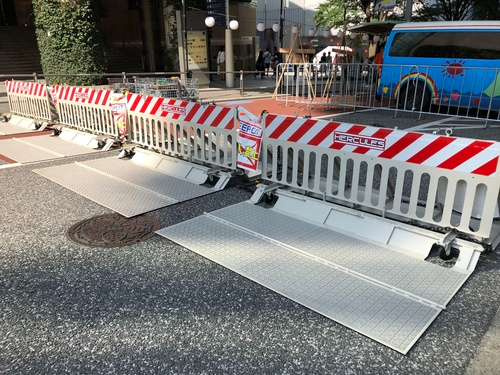
A Hercules barrier installed on a road. The slatted metal sheet is designed to bend and absorb the force of a speeding vehicle.     Source: Try-U

According to Akira Uesugi, Try-U’s representative director, the company developed the product after receiving a request from security authorities to develop a barricade for the 2020 Tokyo Olympics. After three years of development work with universities and other organizations, the new barricade went on sale in May 2019.
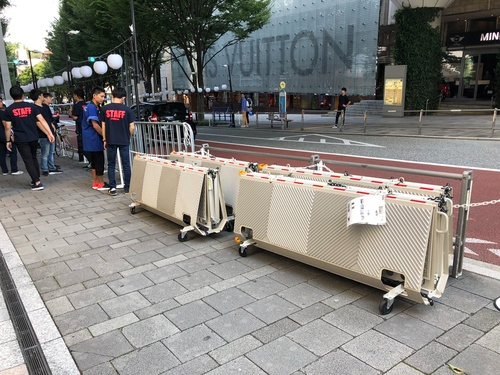
The Hercules barrier is easy to install, foldable and light enough for one person to move around.     Source: Try-U

The company has also used technology from the Hercules in a new product called Barrier Pitto! This smaller barrier is designed to stop cars in more common and unintentional situations, such as when a driver steps on the accelerator pedal by mistake. When a car hits the barrier, most of its force is diverted upwards, helping prevent damage both to the car and the barrier. Unlike barriers such as traffic control bollards, the Pitto does not require the costly need to lay a foundation.

Vehicle-ramming and accidents involving runaway vehicles occur frequently all over the world, causing large numbers of injuries and deaths. During the annual Christmas parade in Waukesha in the United States last November an SUV broke through barriers and drove into the crowd, killing six people and injuring 62 others.

Uesugi says that Try-U’s mission is to prevent such incidents from happening in Japan. But once the effectiveness of the company’s barriers has been demonstrated in Japan, he hopes to start selling them around the world.

Translation and editing by Tony McNicol

Top page photo by Try-U

For inquires about this article, please contact us at jstories@pacificbridge.jp


Click here for the Japanese version of the article.

Tags: accidentbarricadecarcounter-terrorismJapanroad safety
Previous Post

Tea leaves’ second life: Ito En’s sustainable legacy

Next Post

The energy-free cooling breakthrough redefining thermal comfort

Emi Takahata

Emi Takahata

Related Posts

Japan leads global collaboration to combat AI disinformation
AI

Japan leads global collaboration to combat AI disinformation

by Ayaka Sagasaki
03/16/2026
Anime

World-first “anime character-based therapy” trial to test effectiveness in Japanese young adults

by Lucas Maltzman
01/30/2026
Social Impact

From a childhood shaped by conflict to an investor bridging Japan and the world

by Ayaka Sagasaki
01/23/2026
Diversity

What happens when women’s ideas are finally taken seriously?

by HIROKO ISHII
12/12/2025
Diversity

Iceland’s bold break from tradition: The Women’s Day Off that rewrote history

by Sayuri Daimon
12/05/2025
Next Post

The energy-free cooling breakthrough redefining thermal comfort

Leave a Reply Cancel reply

Your email address will not be published. Required fields are marked *

Videos

INTERVIEW | Taking action for peace

11/30/2022

Round-Up Video #38

12/15/2022

Round-Up Video #32

11/03/2022

Browse by Tags

Ai Alternative Energy biotechnology Climate Change Community decarbonization Education Event Food foodtech Health Inclusion Infrastructure Innovation Interview J-Stories Japan Japan-Taiwan Innovation Summit Japan startups Japan Tech Labor Living Nature Podcast Recycling Refugees robotics Society Space Startup Startup Ecosystem Startups SusHI Tech Tokyo Sustainability Sustainable Society Taiwan Technology Tokyo Tokyo Innovation Base Tokyo Metropolitan Government Tokyo Updates venture capital video Wealth Zero Waste
JStories

©Articles and photos published on JSTORIES are protected by Japanese copyright law and international treaties. They cannot be reproduced without the permission of the copyright holders

Explore JStories

  • About Jstories
  • Company
  • Contact
  • Home
  • Partner Press Releases
  • Pricing
  • Privacy Policy
  • Team

Follow Us

Welcome Back!

Login to your account below

Forgotten Password?

Retrieve your password

Please enter your username or email address to reset your password.

Log In
No Result
View All Result
  • Home
  • AI
    • Artificial Intelligence
    • Robotics
    • Mobility
  • Earth
    • Energy
    • Climate Tech
    • AgriTech
    • Clean Tech
    • Disaster Tech
    • SpaceTech
  • Life Sciences
    • BioTech
    • HealthTech
    • MedTech
    • AgeTech
  • Society
    • Media
    • EdTech
    • Diversity
    • FemTech
    • HRTech
    • LegalTech
    • Social Impact
    • FinTech
    • Anime
  • Lifestyle
    • FoodTech
    • FashionTech
    • BeautyTech
    • Wellbeing
    • Art & Music
  • Travel
    • Adventure Travel
    • Luxury Travel
    • Wellness & Medical Tourism
    • Culture
  • Video
  • Deals
    • Venture Capital
    • M&A
    • Startup Events
    • Ecosystem Support
  • Interview
  • Opinion

©Articles and photos published on JSTORIES are protected by Japanese copyright law and international treaties. They cannot be reproduced without the permission of the copyright holders

Are you sure want to unlock this post?
Unlock left : 0
Are you sure want to cancel subscription?