• Login
Upgrade
JStories
  • 日本語
  • 中文 (中国)
No Result
View All Result
  • Home
  • AI
    • Artificial Intelligence
    • Robotics
    • Mobility
  • Earth
    • Energy
    • Climate Tech
    • AgriTech
    • Clean Tech
    • Disaster Tech
    • SpaceTech
  • Life Sciences
    • BioTech
    • HealthTech
    • MedTech
    • AgeTech
  • Society
    • Media
    • EdTech
    • Diversity
    • FemTech
    • HRTech
    • LegalTech
    • Social Impact
    • FinTech
    • Anime
  • Lifestyle
    • FoodTech
    • FashionTech
    • BeautyTech
    • Wellbeing
    • Art & Music
  • Travel
    • Adventure Travel
    • Luxury Travel
    • Wellness & Medical Tourism
    • Culture
  • Video
  • Deals
    • Venture Capital
    • M&A
    • Startup Events
    • Pitch
    • Ecosystem Support
  • Interview
  • Opinion
  • Home
  • AI
    • Artificial Intelligence
    • Robotics
    • Mobility
  • Earth
    • Energy
    • Climate Tech
    • AgriTech
    • Clean Tech
    • Disaster Tech
    • SpaceTech
  • Life Sciences
    • BioTech
    • HealthTech
    • MedTech
    • AgeTech
  • Society
    • Media
    • EdTech
    • Diversity
    • FemTech
    • HRTech
    • LegalTech
    • Social Impact
    • FinTech
    • Anime
  • Lifestyle
    • FoodTech
    • FashionTech
    • BeautyTech
    • Wellbeing
    • Art & Music
  • Travel
    • Adventure Travel
    • Luxury Travel
    • Wellness & Medical Tourism
    • Culture
  • Video
  • Deals
    • Venture Capital
    • M&A
    • Startup Events
    • Pitch
    • Ecosystem Support
  • Interview
  • Opinion
en English ja 日本語 zh 中文 (中国)
JStories
No Result
View All Result

Making eco-friendly fabric by fermenting protein

Yui Sawada by Yui Sawada
07/25/2022
in AI, Clean Tech, Earth, FashionTech, Lifestyle, Mobility
0
Home AI
Share on FacebookShare on Twitter

J-STORIES – As a graduate student, Kazuhide Sekiyama researched artificial spider silk, hoping to develop a strong and flexible material for making clothes. But when his research reached a dead end, he turned his attention to another artificial material inspired by nature: protein fiber. Now he is the CEO of Japanese biomaterials startup Spiber Inc., which has developed a material called “Brewed Protein.”

The company is already working with global apparel outfits to develop products containing the fibre, but potential applications extend well beyond clothing. They include leather and fur, artificial hair, and also auto parts, such as door panels and seats.

Two major advantages of the material is that it is highly biodegradable and recyclable.

To make the protein, 20 types of amino acids are combined. The genetic information of the protein is then designed from a vast number of sequences according to the material’s target use. After that, the DNA is inserted into a microorganism, which is cultured by fermentation technology to produce protein material.

​​The proteins have a molecular structure consisting of dozens to thousands of linear chains of 20 different amino acids, which can be arranged and combined in an almost infinite number of ways.

In order to create proteins for specific applications, the company calculates a vast number of combinations, then designs and synthesizes gene sequences to be incorporated into microorganisms. The microorganisms are then cultured using fermentation technology on a large scale to produce Brewed Protein.
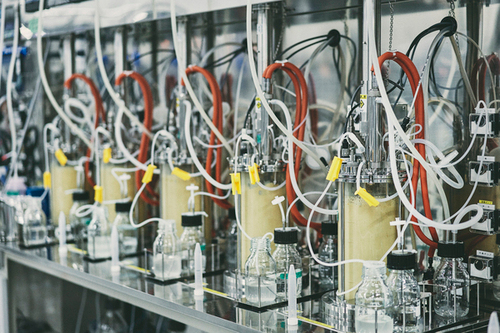
Small-scale microbial culture devices at Spiber’s HQ laboratory.      Source: Spiber

Natural protein materials, such as cotton, hemp, cashmere and silk often end up incinerated as waste due to the high cost of recovery and recycling. But, according to the company, Brewed Protein is easier to reuse, potentially creating a sustainable resource cycle.

Among the global apparel makers Spider has already joined forces with to develop products are Goldwin and The North Face. It also has a tie-up with sustainable fashion maker Pangaia. A hoodie made using the fabric went on sale online in June.

Meanwhile, its manufacturing web is rapidly expanding. Spiber’s Japan plant produces just a few tons of Brewed Protein a year, but this May a plant in Thailand opened with the goal of producing several hundred tons a year. Another plant in the United States planned jointly with U.S. company ADM aims to start production during 2023 to manufacture several thousand tons of the protein a year.
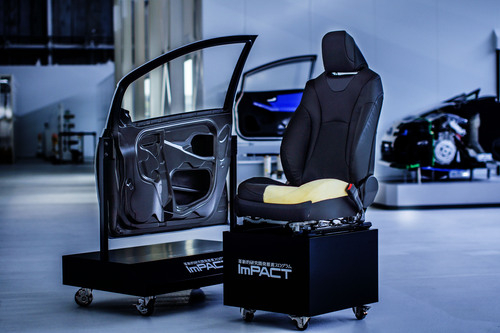
A light and shock-absorbing composite material suitable for car door panels can be made by combining the artificial protein fiber with existing materials such as carbon fiber.      Source: ImPACT

Spiber is also working with Kojima Industries Corp., an auto parts manufacturer that supplies Toyota Motor Corp., to develop a new material with the potential to replace steel. If realized, this material could reduce car body weight, thereby improving fuel efficiency and cutting CO2 emissions.
Spiber spokesperson, Akane Asai, told J-Stories that the company’s material is highly biodegradable because it is made without petroleum. On the other hand, the production process requires more electricity compared to making synthetic fibers. So, a future goal for the company is to reduce its environmental impact by using 100% renewable energy.
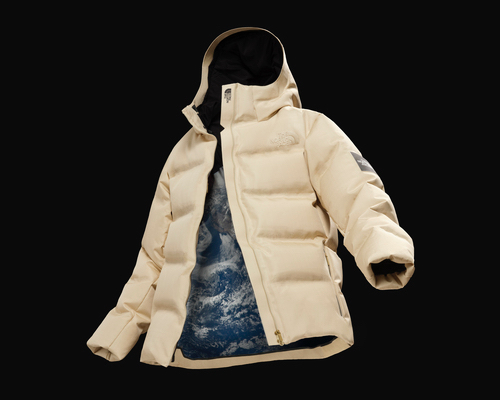
Spiber says its Moon Parka, jointly developed by Goldwin Inc., is the world’s first outwear jacket to utilize structural protein materials. The jacket went on sale in 2019 for 150,000 yen, or roughly 1,100 US dollars.    Source: Spiber

Translation and Editing by Tony McNicol

Top page photo by Spiber

For inquires about this article, please contact us at jstories@pacificbridge.jp


Click here for the Japanese version of the article.

Tags: SustainabilitySustainable SocietyTechnologyZero Waste
Previous Post

Round-up Video #21

Next Post

School in the time of war

Yui Sawada

Yui Sawada

Related Posts

Japan leads global collaboration to combat AI disinformation
AI

Japan leads global collaboration to combat AI disinformation

by Ayaka Sagasaki
03/16/2026
Starting a sustainable wood-fired bakery in Tokyo
FoodTech

Starting a sustainable wood-fired bakery in Tokyo

by Tokyo Updates
03/05/2026
Clean Tech

Japanese startup turns eggshell waste into eco-friendly plastics and paper

by Yoshiko Ohira
02/06/2026
Earth

A world first: Detecting road sinkholes from space

by Ayaka Sagasaki
01/30/2026
Lifestyle

The plush toy hospital keeping childhood memories alive

by Tokyo Updates
01/30/2026
Next Post

School in the time of war

Leave a Reply Cancel reply

Your email address will not be published. Required fields are marked *

Videos

Round-up Video #28

09/29/2022

Taking action for peace

11/30/2022

Round-Up Video #39

12/22/2022

Browse by Tags

Ai Alternative Energy biotechnology Climate Change Community decarbonization Education Event Food foodtech Health Inclusion Infrastructure Innovation Interview J-Stories Japan Japan-Taiwan Innovation Summit Japan startups Japan Tech Labor Living Nature Podcast Recycling Refugees robotics Society Space Startup Startup Ecosystem Startups SusHI Tech Tokyo Sustainability Sustainable Society Taiwan Technology Tokyo Tokyo Innovation Base Tokyo Metropolitan Government Tokyo Updates venture capital video Wealth Zero Waste
JStories

©Articles and photos published on JSTORIES are protected by Japanese copyright law and international treaties. They cannot be reproduced without the permission of the copyright holders

Explore JStories

  • About Jstories
  • Company
  • Contact
  • Home
  • Partner Press Releases
  • Pricing
  • Privacy Policy
  • Team

Follow Us

Welcome Back!

Login to your account below

Forgotten Password?

Retrieve your password

Please enter your username or email address to reset your password.

Log In
No Result
View All Result
  • Home
  • AI
    • Artificial Intelligence
    • Robotics
    • Mobility
  • Earth
    • Energy
    • Climate Tech
    • AgriTech
    • Clean Tech
    • Disaster Tech
    • SpaceTech
  • Life Sciences
    • BioTech
    • HealthTech
    • MedTech
    • AgeTech
  • Society
    • Media
    • EdTech
    • Diversity
    • FemTech
    • HRTech
    • LegalTech
    • Social Impact
    • FinTech
    • Anime
  • Lifestyle
    • FoodTech
    • FashionTech
    • BeautyTech
    • Wellbeing
    • Art & Music
  • Travel
    • Adventure Travel
    • Luxury Travel
    • Wellness & Medical Tourism
    • Culture
  • Video
  • Deals
    • Venture Capital
    • M&A
    • Startup Events
    • Ecosystem Support
  • Interview
  • Opinion

©Articles and photos published on JSTORIES are protected by Japanese copyright law and international treaties. They cannot be reproduced without the permission of the copyright holders

Are you sure want to unlock this post?
Unlock left : 0
Are you sure want to cancel subscription?