
• Login
Upgrade
JStories
  • 日本語
  • 中文 (中国)
No Result
View All Result
  • Home
  • AI
    • Artificial Intelligence
    • Robotics
    • Mobility
  • Earth
    • Energy
    • Climate Tech
    • AgriTech
    • Clean Tech
    • Disaster Tech
    • SpaceTech
  • Life Sciences
    • BioTech
    • HealthTech
    • MedTech
    • AgeTech
  • Society
    • Media
    • EdTech
    • Diversity
    • FemTech
    • HRTech
    • LegalTech
    • Social Impact
    • FinTech
    • Anime
  • Lifestyle
    • FoodTech
    • FashionTech
    • BeautyTech
    • Wellbeing
    • Art & Music
  • Travel
    • Adventure Travel
    • Luxury Travel
    • Wellness & Medical Tourism
    • Culture
  • Video
  • Deals
    • Venture Capital
    • M&A
    • Startup Events
    • Pitch
    • Ecosystem Support
  • Interview
  • Opinion
  • Home
  • AI
    • Artificial Intelligence
    • Robotics
    • Mobility
  • Earth
    • Energy
    • Climate Tech
    • AgriTech
    • Clean Tech
    • Disaster Tech
    • SpaceTech
  • Life Sciences
    • BioTech
    • HealthTech
    • MedTech
    • AgeTech
  • Society
    • Media
    • EdTech
    • Diversity
    • FemTech
    • HRTech
    • LegalTech
    • Social Impact
    • FinTech
    • Anime
  • Lifestyle
    • FoodTech
    • FashionTech
    • BeautyTech
    • Wellbeing
    • Art & Music
  • Travel
    • Adventure Travel
    • Luxury Travel
    • Wellness & Medical Tourism
    • Culture
  • Video
  • Deals
    • Venture Capital
    • M&A
    • Startup Events
    • Pitch
    • Ecosystem Support
  • Interview
  • Opinion
en English ja 日本語 zh 中文 (中国)
JStories
No Result
View All Result

World-first technology controls ratio of female to male pigs

Yoshiko Ohira by Yoshiko Ohira
05/22/2024
in AgriTech, BioTech, Clean Tech, Deals, Earth, Ecosystem Support, Life Sciences
0
Home Earth AgriTech
Share on FacebookShare on Twitter

J-STORIES – Against a backdrop of environmental destruction, growing concerns over animal welfare, and worries about food shortages, the global meat industry must address an urgent question: How can it make meat production more efficient and sustainable?

A potential solution is “sex-sorting” technology that separates male and female sperm to control the sex ratio in pig farming. By increasing the ratio of female to male pigs it can be used to improve production efficiency, and also animal welfare because fewer males need to be castrated.

Sex-sorting technology has already brought improvements to cattle and chicken farming, but so far implementation in pig farming has been limited. Now, Japanese startup Lullabio has devised a simple method of controlling the sex ratio in pigs based on cutting-edge technology, which it aims to commercialize within three years.

Bottles of the sex-sorting chemical reagent.     Source: Lullabio

Lullabio was founded at Hiroshima University and is headed by CEO Mitsuhiko Shirakawa. It uses technology for easy sex sorting of mammals that was developed by a research group led by the university’s professor Masayuki Shimada and announced in 2019. It is the world’s first technology to efficiently control the sex ratio in pig farming.
Source: envato

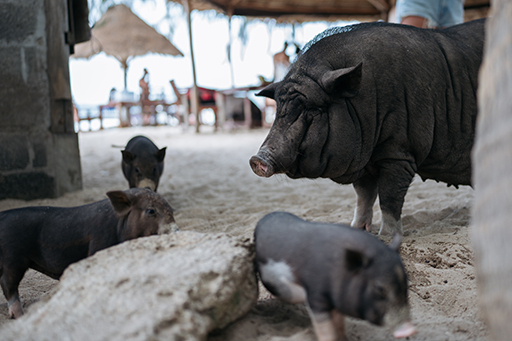
Sex-sorting technology in livestock farming has significant benefits, such as the ability to adjust the sex ratio for different purposes, reducing feed consumption, and reducing environmental impact. It is done by sorting X-bearing (female) and Y-bearing (male) sperm. In cattle, sorting is already common using a device called a flow cytometer.
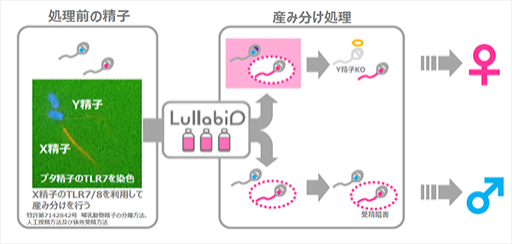
X and Y sperm are separated when a reagent that binds to the receptor is put into pig semen.     Source: Lullabio

These devices, however, are expensive to purchase and maintain, making the technique difficult to use when farming pigs, which are sold at a significantly lower price than cattle. Another problem is that more sperm need to be sorted when the technology is applied to pigs. According to Shirakawa, using current flow cytometers, the number of sperm that must be sorted to breed one head of cattle is 2 million, but for a pig the number is 2 billion. He explains that it is difficult to sort so many sperm in a short time, and if it takes too long, the sperm will die. For these reasons, few pig farming companies use flow cytometer technology.
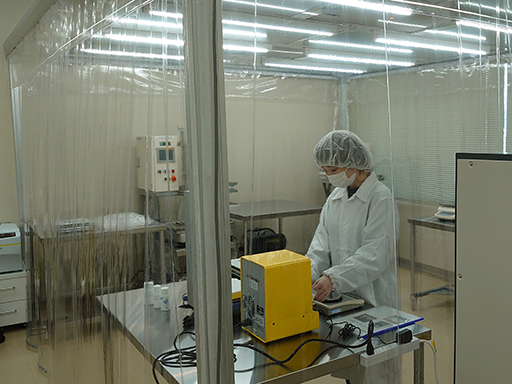
Producing the chemical reagent in a sterile room.       Source: Lullabio

Professor Shimada’s research led to a completely different technique. Instead of a flow cytometer, it uses a drug that binds to a receptor found only in mammalian X-bearing sperm, making it possible to easily separate X-bearing (female) and Y-bearing (male) sperm and use them in artificial insemination. Lullabio is responsible for the development, manufacture and marketing of the new chemical.
Source: envato

Although flow cytometer sex-sorting technology is already used in cattle farming, and in chicken farming through a different method, pig farming currently has no practical technique. Shirakawa describes it as a “blue ocean” market.

Lullabio has already signed a license agreement with Hiroshima University for use of its patents and is staging demonstration tests of its reagent at pig farms and pig breeding companies. Shirakawa says that sorting accuracy is currently around 60%, with different results depending on the type of pig and the breeding company. The immediate challenge, he adds, is how to improve this accuracy, and how to raise money for research to make that possible.

The size of the global meat market has been put at 200 trillion yen, of which the pig farming industry accounts for 20%. Japan meanwhile, only makes up 1.5% of a 300 billion yen market for sex sorting in pig farming, so the company also intends to target the USA and Europe. Lullabio estimates the effective global market for their technology at around 56 billion yen, excluding China and Russia.

“By efficiently producing the right number of pigs, businesses can expect to use less feed. What’s more, castration costs can be reduced, which is also beneficial from an animal-welfare perspective. Also, there are significant social ripple effects, such as reductions in greenhouse gas emissions and continuing meat-eating culture.”- Lullabio CEO Mitsuhiko Shirakawa      Source: Lullabio

According to the company, while human application of the technology is theoretically possible, for ethical and patent-related reasons such research is currently not done.

Shirakawa says that the technology could have numerous benefits.

“By efficiently producing the right number of pigs, businesses can expect to use less feed. What’s more, castration costs can be reduced, which is also beneficial from an animal-welfare perspective. Also, there are significant social ripple effects, such as reductions in greenhouse gas emissions and continuing meat-eating culture.”

Translation by Tony McNicol

Top page photo by Lullabio

For inquires about this article, please contact us at jstories@pacificbridge.jp

***

Click here for the Japanese version of the article.

Tags: Agricultureanimal welfarebiotechnologyEnvironmental ImpactFood SecurityHiroshima UniversityJapan TechLivestock InnovationLullabioMeat IndustryPig FarmingSelective BreedingSex-sorting TechnologySustainabilityX and Y Sperm
Previous Post

Avatar robots provide a new form of customer service

Next Post

SusHi Tech Tokyo 2024 aims to become a global hub for Asian startups

Yoshiko Ohira

Yoshiko Ohira

Related Posts

Japan leads global collaboration to combat AI disinformation
AI

Japan leads global collaboration to combat AI disinformation

by Ayaka Sagasaki
03/16/2026
Deals

More than 700 startups to gather at SusHi Tech Tokyo 2026, Asia’s largest global innovation conference

by Toshi Maeda
02/20/2026
HealthTech

Engineering safety from the ground up

by Tokyo Updates
02/13/2026
Clean Tech

Japanese startup turns eggshell waste into eco-friendly plastics and paper

by Yoshiko Ohira
02/06/2026
Earth

A world first: Detecting road sinkholes from space

by Ayaka Sagasaki
01/30/2026
Next Post

SusHi Tech Tokyo 2024 aims to become a global hub for Asian startups

Leave a Reply Cancel reply

Your email address will not be published. Required fields are marked *

Videos

Round-Up Video #34

11/17/2022

Round-Up Video #39

12/22/2022

Round-up Video #21

07/21/2022

Browse by Tags

Ai Alternative Energy biotechnology Climate Change Community decarbonization Education Event Food foodtech Health Inclusion Infrastructure Innovation Interview J-Stories Japan Japan-Taiwan Innovation Summit Japan startups Japan Tech Labor Living Nature Podcast Recycling Refugees robotics Society Space Startup Startup Ecosystem Startups SusHI Tech Tokyo Sustainability Sustainable Society Taiwan Technology Tokyo Tokyo Innovation Base Tokyo Metropolitan Government Tokyo Updates venture capital video Wealth Zero Waste
JStories

©Articles and photos published on JSTORIES are protected by Japanese copyright law and international treaties. They cannot be reproduced without the permission of the copyright holders

Explore JStories

  • About Jstories
  • Company
  • Contact
  • Home
  • Partner Press Releases
  • Pricing
  • Privacy Policy
  • Team

Follow Us

Welcome Back!

Login to your account below

Forgotten Password?

Retrieve your password

Please enter your username or email address to reset your password.

Log In
No Result
View All Result
  • Home
  • AI
    • Artificial Intelligence
    • Robotics
    • Mobility
  • Earth
    • Energy
    • Climate Tech
    • AgriTech
    • Clean Tech
    • Disaster Tech
    • SpaceTech
  • Life Sciences
    • BioTech
    • HealthTech
    • MedTech
    • AgeTech
  • Society
    • Media
    • EdTech
    • Diversity
    • FemTech
    • HRTech
    • LegalTech
    • Social Impact
    • FinTech
    • Anime
  • Lifestyle
    • FoodTech
    • FashionTech
    • BeautyTech
    • Wellbeing
    • Art & Music
  • Travel
    • Adventure Travel
    • Luxury Travel
    • Wellness & Medical Tourism
    • Culture
  • Video
  • Deals
    • Venture Capital
    • M&A
    • Startup Events
    • Ecosystem Support
  • Interview
  • Opinion

©Articles and photos published on JSTORIES are protected by Japanese copyright law and international treaties. They cannot be reproduced without the permission of the copyright holders

Are you sure want to unlock this post?
Unlock left : 0
Are you sure want to cancel subscription?