• Login
Upgrade
JStories
  • 日本語
  • 中文 (中国)
No Result
View All Result
  • Home
  • AI
    • Artificial Intelligence
    • Robotics
    • Mobility
  • Earth
    • Energy
    • Climate Tech
    • AgriTech
    • Clean Tech
    • Disaster Tech
    • SpaceTech
  • Life Sciences
    • BioTech
    • HealthTech
    • MedTech
    • AgeTech
  • Society
    • Media
    • EdTech
    • Diversity
    • FemTech
    • HRTech
    • LegalTech
    • Social Impact
    • FinTech
    • Anime
  • Lifestyle
    • FoodTech
    • FashionTech
    • BeautyTech
    • Wellbeing
    • Art & Music
  • Travel
    • Adventure Travel
    • Luxury Travel
    • Wellness & Medical Tourism
    • Culture
  • Video
  • Deals
    • Venture Capital
    • M&A
    • Startup Events
    • Pitch
    • Ecosystem Support
  • Interview
  • Opinion
  • Home
  • AI
    • Artificial Intelligence
    • Robotics
    • Mobility
  • Earth
    • Energy
    • Climate Tech
    • AgriTech
    • Clean Tech
    • Disaster Tech
    • SpaceTech
  • Life Sciences
    • BioTech
    • HealthTech
    • MedTech
    • AgeTech
  • Society
    • Media
    • EdTech
    • Diversity
    • FemTech
    • HRTech
    • LegalTech
    • Social Impact
    • FinTech
    • Anime
  • Lifestyle
    • FoodTech
    • FashionTech
    • BeautyTech
    • Wellbeing
    • Art & Music
  • Travel
    • Adventure Travel
    • Luxury Travel
    • Wellness & Medical Tourism
    • Culture
  • Video
  • Deals
    • Venture Capital
    • M&A
    • Startup Events
    • Pitch
    • Ecosystem Support
  • Interview
  • Opinion
en English ja 日本語 zh 中文 (中国)
JStories
No Result
View All Result

Researchers make semiconductor nanocrystals from rice husks

Yui Sawada by Yui Sawada
05/02/2022
in AI, BioTech, Clean Tech, Earth, Life Sciences, Robotics
0
Home AI
Share on FacebookShare on Twitter

J-STORIES – A research group at Hiroshima University has developed an eco-friendly next-generation LED. Instead of toxic rare earths and metals, they used rice husks to create minute semiconductor nanocrystals called “quantum dots” for use in displays.

The university is believed to be the first in the world to announce research results into the use of rice husks to manufacture LEDs. The use of quantum dots as semiconductor nanoparticles in displays and other devices is expected to become more widespread.

But there are problems: They contain toxic metals such as cadmium and lead. And the supply of rare earths and rare metals is unstable.

The university’s research results are expected to pave the way for safe quantum dots made from natural materials. At the same time, it provides an effective way to use the huge amounts of rice husks that farmers struggle to dispose of.
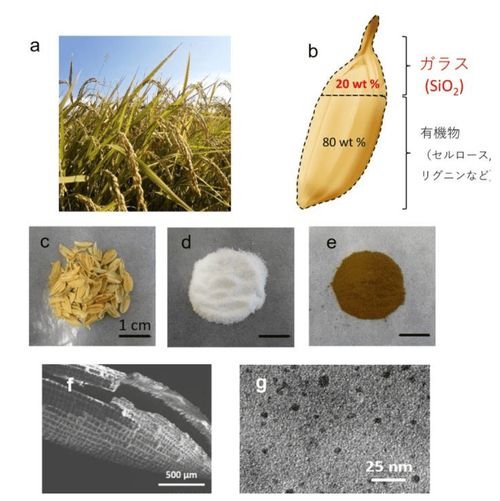
A process from extracting silicon powder from rice husks to generating light-emitting “silicon quantum dots.” (Bottom right)          Courtesy: Hiroshima University

Quantum dots are light-emitting semiconductor microparticles several nanometers in diameter (one nanometer is one millionth of a millimeter). Due to their minute size, as well as wide and beautiful range of colors, it’s expected they will be increasingly used as light sources in wearable devices and other applications that require higher resolutions. According to one U.S. research firm, the market for quantum dots is expected to reach $8.6 billion by 2026.

Quantum dots contain cadmium, a metal that was once a massive pollution problem in Japan and the cause of “itai-itai disease” (cadmium poisoning). In the process of developing quantum dot LEDs that are free from such toxicity and can be produced safely and stably, the research team turned its attention to rice husks, a by-product that farmers struggle to dispose of. The research group used the silica that makes up approximately 20 percent of rice husks to produce quantum dots, and succeeded in creating a quantum dot LED that emits orange light.
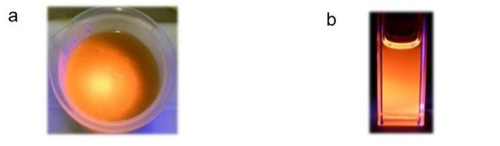
Generated silicon quantum dots emitting orange light     Courtesy: Hiroshima University

Professor Kenichi Saito, who leads the university research group, told J-Stories that their goal is to increase the brightness of the light while adding other colors, such as red, blue, and green. According to Saito, if these rice husk-derived quantum dots can be mass-produced, they could be used as light-emitting materials in displays for more precise virtual reality headsets, as well as contact lenses and glasses that can show images. He says that they could even play a role in the development of hologram technology.

“I want to make something that will surprise the world,” said Saito. “Light can be used in many places and can do anything. Two or three decades from now, I want to have used quantum dots and quantum dot LEDs to bring about a world that we could never have imagined.”
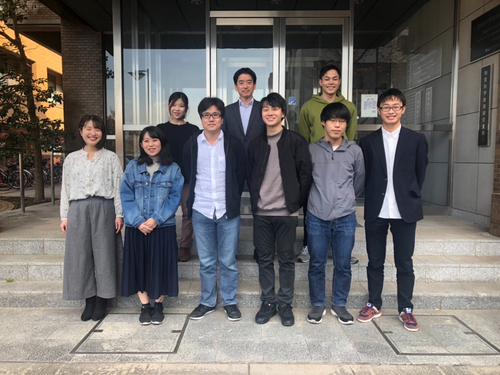
The Hiroshima University research group that successfully generated quantum dot LEDs from rice husks       Courtesy: Hiroshima University

Translation and Editing by Tony McNicol

Top page photo by HumbaFrame/Envato

For inquires about this article, please contact us at jstories@pacificbridge.jp


Click here for the Japanese version of the article.

Tags: ArEcoLedQuantum DotsRiceVr
Previous Post

Interview with Japan’s refugee matchmaker

Next Post

Round-up Video #10

Yui Sawada

Yui Sawada

Related Posts

Japan leads global collaboration to combat AI disinformation
AI

Japan leads global collaboration to combat AI disinformation

by Ayaka Sagasaki
03/16/2026
HealthTech

Engineering safety from the ground up

by Tokyo Updates
02/13/2026
Clean Tech

Japanese startup turns eggshell waste into eco-friendly plastics and paper

by Yoshiko Ohira
02/06/2026
Earth

A world first: Detecting road sinkholes from space

by Ayaka Sagasaki
01/30/2026
AgriTech

Fish scraps as a hidden treasure

by Kei Mizuno
01/16/2026
Next Post

Round-up Video #10

Leave a Reply Cancel reply

Your email address will not be published. Required fields are marked *

Videos

Round-up Video #21

07/21/2022

Round-Up Video #33

11/10/2022

Round-up Video #13

05/26/2022

Browse by Tags

Ai Alternative Energy biotechnology Climate Change Community decarbonization Education Event Food foodtech Health Inclusion Infrastructure Innovation Interview J-Stories Japan Japan-Taiwan Innovation Summit Japan startups Japan Tech Labor Living Nature Podcast Recycling Refugees robotics Society Space Startup Startup Ecosystem Startups SusHI Tech Tokyo Sustainability Sustainable Society Taiwan Technology Tokyo Tokyo Innovation Base Tokyo Metropolitan Government Tokyo Updates venture capital video Wealth Zero Waste
JStories

©Articles and photos published on JSTORIES are protected by Japanese copyright law and international treaties. They cannot be reproduced without the permission of the copyright holders

Explore JStories

  • About Jstories
  • Company
  • Contact
  • Home
  • Partner Press Releases
  • Pricing
  • Privacy Policy
  • Team

Follow Us

Welcome Back!

Login to your account below

Forgotten Password?

Retrieve your password

Please enter your username or email address to reset your password.

Log In
No Result
View All Result
  • Home
  • AI
    • Artificial Intelligence
    • Robotics
    • Mobility
  • Earth
    • Energy
    • Climate Tech
    • AgriTech
    • Clean Tech
    • Disaster Tech
    • SpaceTech
  • Life Sciences
    • BioTech
    • HealthTech
    • MedTech
    • AgeTech
  • Society
    • Media
    • EdTech
    • Diversity
    • FemTech
    • HRTech
    • LegalTech
    • Social Impact
    • FinTech
    • Anime
  • Lifestyle
    • FoodTech
    • FashionTech
    • BeautyTech
    • Wellbeing
    • Art & Music
  • Travel
    • Adventure Travel
    • Luxury Travel
    • Wellness & Medical Tourism
    • Culture
  • Video
  • Deals
    • Venture Capital
    • M&A
    • Startup Events
    • Ecosystem Support
  • Interview
  • Opinion

©Articles and photos published on JSTORIES are protected by Japanese copyright law and international treaties. They cannot be reproduced without the permission of the copyright holders

Are you sure want to unlock this post?
Unlock left : 0
Are you sure want to cancel subscription?