• Login
Upgrade
JStories
  • 日本語
  • 中文 (中国)
No Result
View All Result
  • Home
  • AI
    • Artificial Intelligence
    • Robotics
    • Mobility
  • Earth
    • Energy
    • Climate Tech
    • AgriTech
    • Clean Tech
    • Disaster Tech
    • SpaceTech
  • Life Sciences
    • BioTech
    • HealthTech
    • MedTech
    • AgeTech
  • Society
    • Media
    • EdTech
    • Diversity
    • FemTech
    • HRTech
    • LegalTech
    • Social Impact
    • FinTech
    • Anime
  • Lifestyle
    • FoodTech
    • FashionTech
    • BeautyTech
    • Wellbeing
    • Art & Music
  • Travel
    • Adventure Travel
    • Luxury Travel
    • Wellness & Medical Tourism
    • Culture
  • Video
  • Deals
    • Venture Capital
    • M&A
    • Startup Events
    • Pitch
    • Ecosystem Support
  • Interview
  • Opinion
  • Home
  • AI
    • Artificial Intelligence
    • Robotics
    • Mobility
  • Earth
    • Energy
    • Climate Tech
    • AgriTech
    • Clean Tech
    • Disaster Tech
    • SpaceTech
  • Life Sciences
    • BioTech
    • HealthTech
    • MedTech
    • AgeTech
  • Society
    • Media
    • EdTech
    • Diversity
    • FemTech
    • HRTech
    • LegalTech
    • Social Impact
    • FinTech
    • Anime
  • Lifestyle
    • FoodTech
    • FashionTech
    • BeautyTech
    • Wellbeing
    • Art & Music
  • Travel
    • Adventure Travel
    • Luxury Travel
    • Wellness & Medical Tourism
    • Culture
  • Video
  • Deals
    • Venture Capital
    • M&A
    • Startup Events
    • Pitch
    • Ecosystem Support
  • Interview
  • Opinion
en English ja 日本語 zh 中文 (中国)
JStories
No Result
View All Result

Can a small robot save Japan’s terraced paddies?

Yoshiko Ohira by Yoshiko Ohira
11/28/2025
in AgriTech, Earth
0
Home Earth AgriTech
Share on FacebookShare on Twitter

JStories ー In southern Japan, researchers from the Prefectural University of Kumamoto and the National Institute of Technology, Kumamoto College, have developed a compact spherical robot designed to work in areas of rice paddies that conventional machinery cannot reach. The prototype – nicknamed “Ball Duck”– is part of an effort to create simple, low-cost tools that ease some of the most labor-intensive tasks in rice cultivation and help farmers maintain landscapes increasingly at risk of abandonment.

At the foot of Mount Aso, an active volcano in Kumamoto Prefecture ー a place known for its picturesque terraced paddies ー the latest version of the robot rolls through waterlogged fields, clawing up clusters of weeds embedded in the mud. This was the scene in May, when the research consortium conducted a field test aimed at easing one of rice farmers’ heaviest burdens.
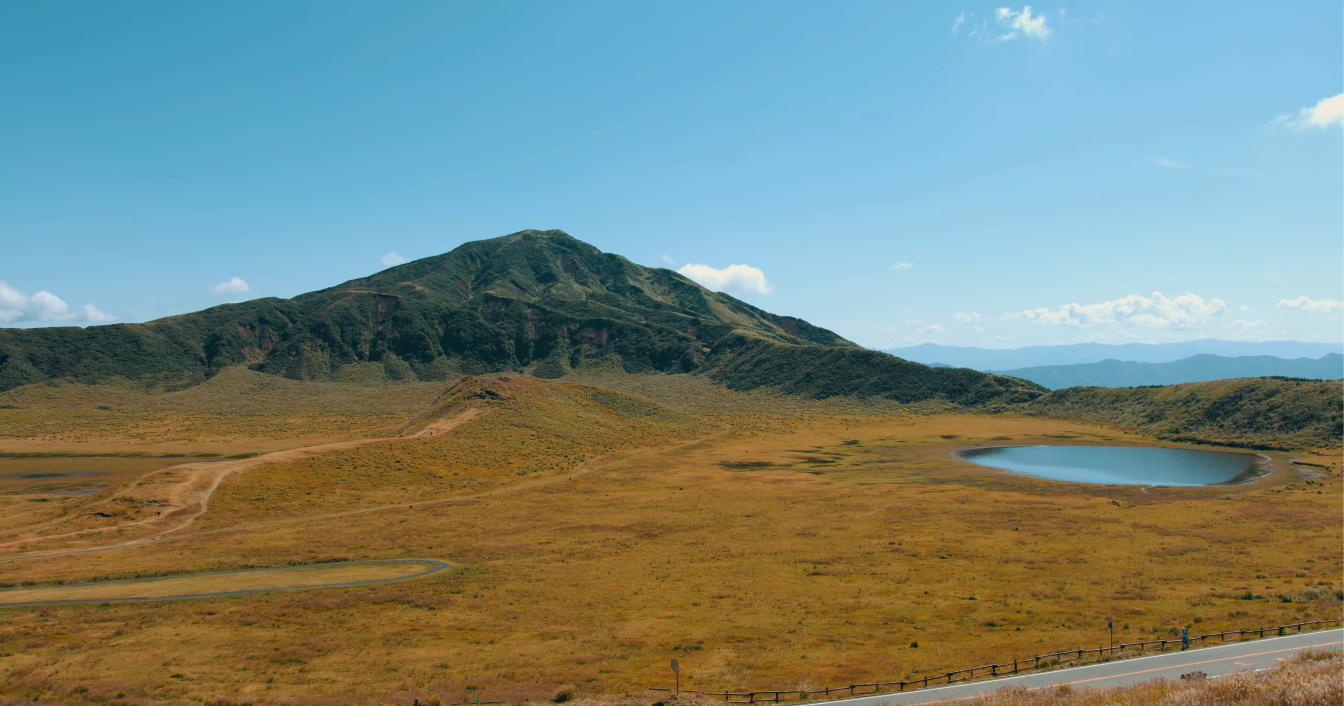
Mount Aso      Source: Envato

Depopulation, an aging workforce, and a shrinking pipeline of successors are placing intense pressure on rice growers. Weeding ー often done in sweltering summer heat ー remains backbreaking work, prompting more farmers to give up cultivation altogether. Terraced paddies, carved into steep slopes and broken into small, irregular plots, are especially challenging: They are said to require twice the labor for half the yield compared with flatland fields, driving a serious abandonment problem.

Weeds such as barnyard grass can significantly reduce rice growth and yields. Yet for small terraces, using medium or large weeding machines is dangerous, if not impossible. A lightweight, autonomous robot that can remove weeds without human labor could not only reduce physical strain and improve safety but also help sustain rice cultivation in these fragile landscapes.

Portable, low-cost, and designed for small paddies

Current weeding methods range from hand labor and mechanical tools to the traditional Japanese “aigamo” method, in which farmers raise hybrid ducks that eat young weeds and insects while stirring up nutrient-rich mud. More recently, robots that churn mud to cloud the water and suppress weed growth have begun to appear.

The new spherical robot under development in Kumamoto takes a different approach: It uproots weeds. Light, inexpensive, and easy to use, it is suited to the small, irregular parcels typical of terraced paddies. The device measures roughly 26 centimeters in diameter, weighs about 4 kilograms, and is expected to be priced around 10,000 yen per unit. Equipped with wireless charging, it runs for about six hours after a three-hour charge.

Inside the sphere, internal wheels generate propulsion. Its weeding power comes from the round nodules that stud the outer shell ー designed to evoke the shape of the Aso caldera, one of Japan’s largest volcanic basins. 

These protrusions churn mud and pull out weeds, and can be customized by weed species or soil type. In August, the consortium secured a patent covering the shell’s structure, materials, and weeding mechanisms.
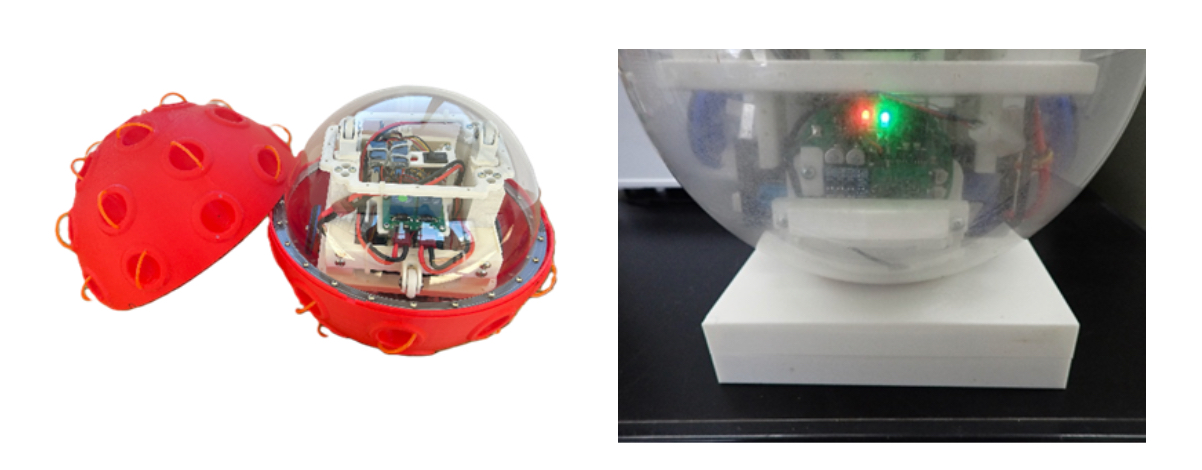
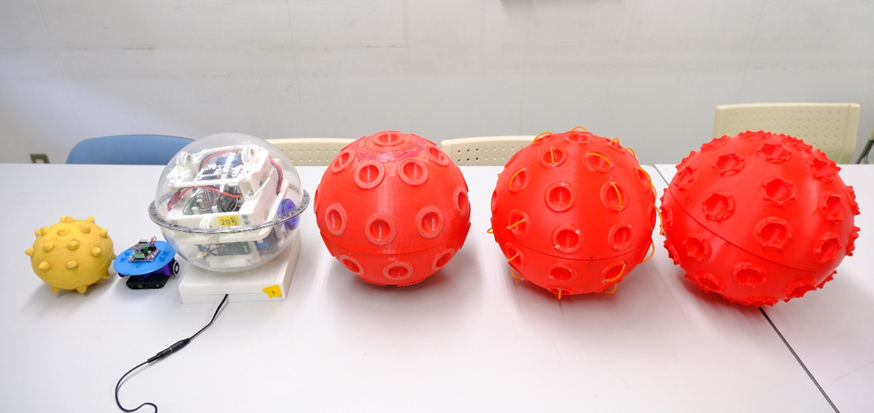
The Ball Duck (left), named after the image of an aigamo duck patrolling the paddy, and its charging unit.Diameter: approx. 26 cm; Weight: approx. 4 kg.           Photo courtesy of the Prefectural University of Kumamoto 
From left: a series of improved spherical robots        Photo by Yoshiko Ohira | JStories

A water depth of about 10 cm is needed for effective operation, typically starting about one week after rice planting. As it rolls, the robot scrapes mud and dredges up weeds such as barnyard grass and monochoria. According to professor Naotaka Matsuzoe, who leads the project, “The robot’s movement has no adverse effect on rice growth or yields.”

Strides toward robots that can navigate terrace steps

Because the robot is autonomous, it can be left in the field without human supervision. In addition to supporting organic rice cultivation by reducing chemical herbicide use, it is far cheaper than deploying large machinery ー easing the economic burden on farmers.

“Japan has set a goal of increasing organic farming acreage to 25% (1 million hectares) by 2050,” Matsuzoe notes. “That means physical methods that reduce pesticide use are being reevaluated. Farmers need to understand the specific conditions of their paddies: when weeds appear, where, and what kinds.”
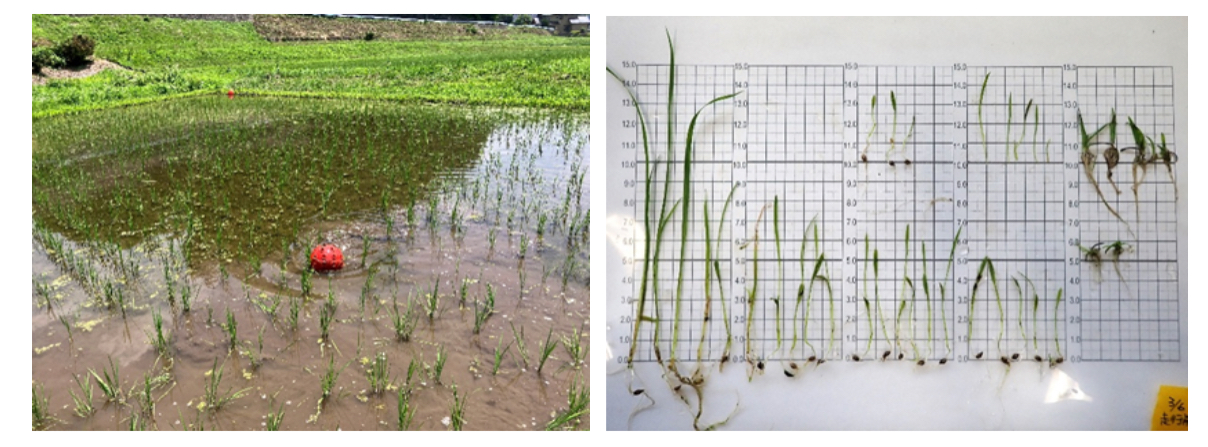
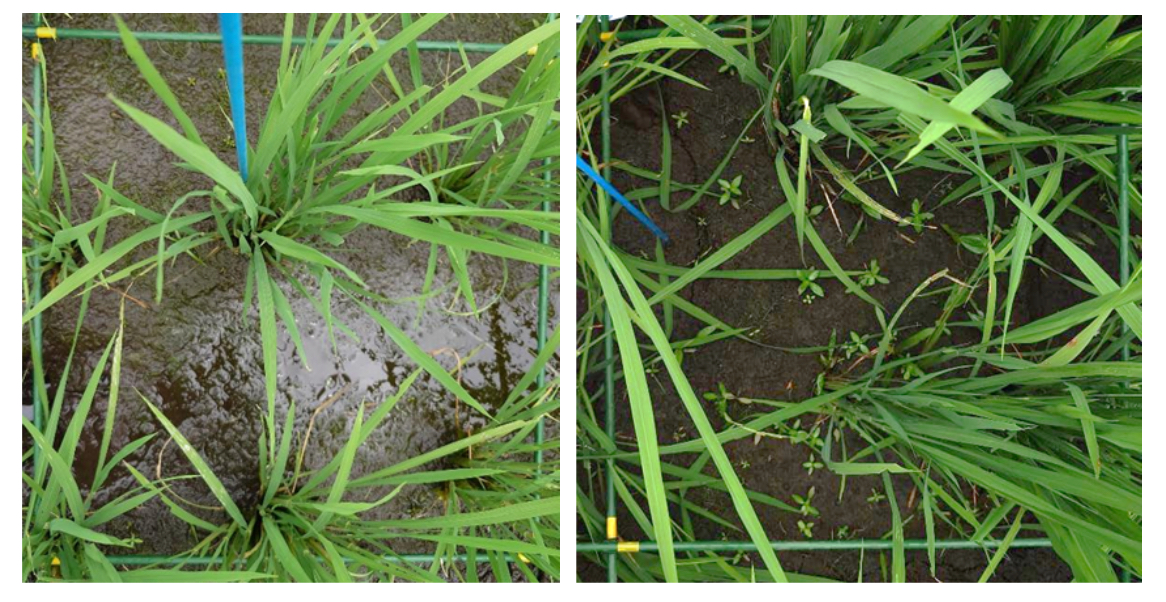
Scenes from the field test and weeds removed from the paddies          Photo courtesy of the Prefectural University of Kumamoto (Same below)
Left to right: comparison between plots where the spherical robot was used and not used

“We’re still in the verification stage,” Matsuzoe adds. “By using a robot control system with short-range wireless beacons, we hope to improve autonomous motion within an invisible boundary and aim for real-world deployment in three to five years. Ultimately, we want a robot that can follow water flow and independently cross the tiered steps of terraced paddies.”

The consortium is also developing a chestnut-harvesting and transport robot as part of its push toward smart agriculture. During trials in August, the device reduced labor during harvest by 65%. After further improvements, a manually operated version with electric assist is planned for release in August 2026.
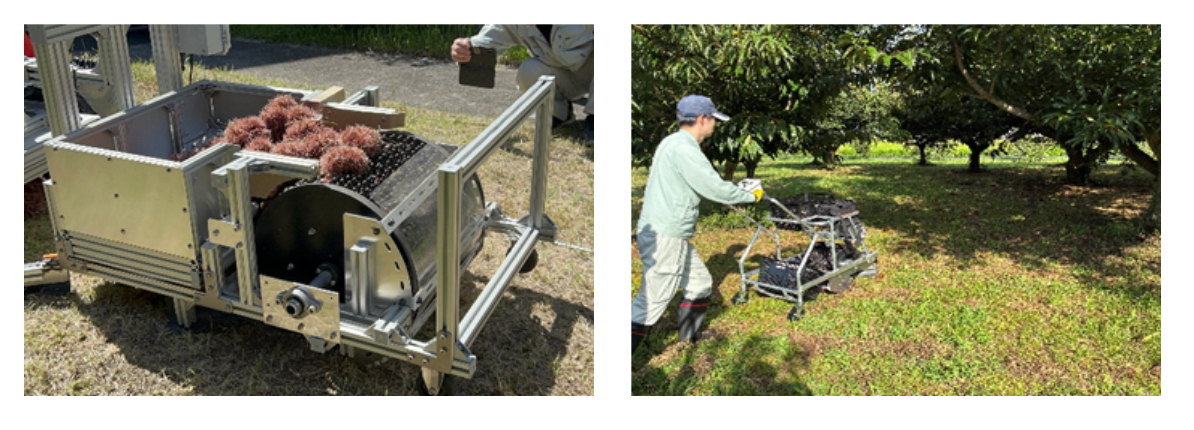
Chestnut-harvesting and transport robot developed by the Prefectural University of Kumamoto, the National Institute of Technology, Kumamoto College, Suematsu Electronics, and others. The robot has attracted attention from chestnut farmers in Ibaraki Prefecture, Japan’s top producer of chestnuts

Strong interest at Osaka-Kansai Expo ー and potential in Southeast Asia

When the spherical weeding robot was exhibited at the Osaka-Kansai Expo in June 2025, it drew significant public interest. “The struggle to maintain terraced paddies isn’t unique to Japan,” says Matsuzoe. “Many Southeast Asian countries cultivate rice in similar terrain, and some areas remain untouched. I hope Japan can share its advanced agricultural technologies with its neighbors.”
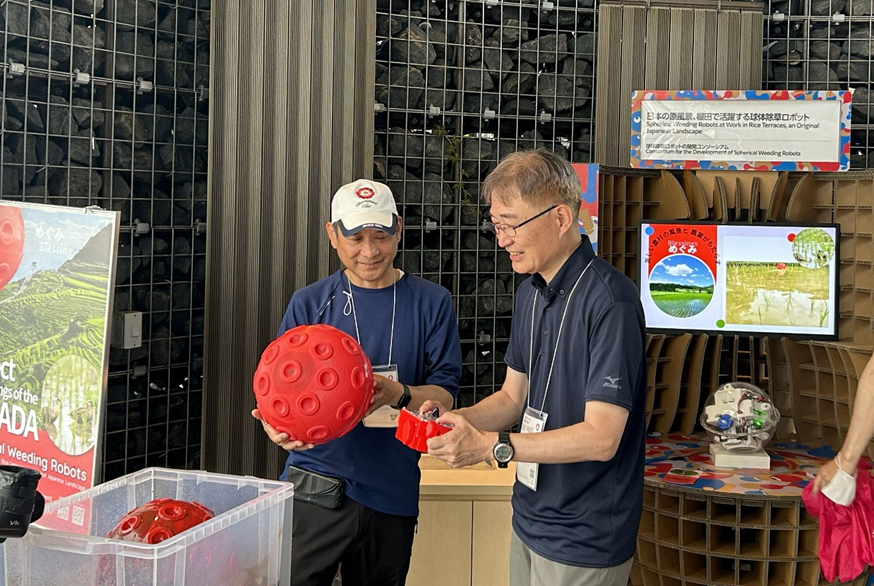
Matsuzoe (left) and professor Junichiro Yuji of the National Institute of Technology, Kumamoto College, explain the robot at the Osaka-Kansai Expo

“Protecting agriculture in mountainous and hilly areas ー not just growing rice ー supports groundwater conservation and sustains diverse aquatic ecosystems. With climate change bringing heavier rains and more frequent flooding, flatland farmland alone won’t secure our food supply. To ensure long-term food stability, we must urgently build sustainable agriculture that preserves terraced paddies in these regions.”

Translated by Anita De Michele | JStories

Edited by Mark Goldsmith

Top photo: Photo courtesy of the Prefectural University of Kumamoto

For inquiries regarding this article, please contact jstories@pacificbridge.jp


Click here for the Japanese version of the article

Previous Post

A new era of marketing, pioneered by generative AI

Next Post

App-based interpreting service supports global business and community

Yoshiko Ohira

Yoshiko Ohira

Related Posts

Clean Tech

Japanese startup turns eggshell waste into eco-friendly plastics and paper

by Yoshiko Ohira
02/06/2026
Earth

A world first: Detecting road sinkholes from space

by Ayaka Sagasaki
01/30/2026
AgriTech

Fish scraps as a hidden treasure

by Kei Mizuno
01/16/2026
Clean Tech

From swordfish to blue jeans: How a Japanese craftsman turns waste into wear

by Yoshiko Ohira
11/07/2025
Earth

Space technology meets everyday life: The Tokyo-based startup taking on the apparel of the future

by Tokyo Updates
11/07/2025
Next Post

App-based interpreting service supports global business and community

Leave a Reply Cancel reply

Your email address will not be published. Required fields are marked *

Videos

Round-up Video #25

09/01/2022

Round-Up Video #35

11/24/2022

Round-up Video #24

08/25/2022

Browse by Tags

Ai Alternative Energy biotechnology Climate Change Community decarbonization Education Event Food foodtech Health Inclusion Infrastructure Innovation Interview J-Stories Japan Japan-Taiwan Innovation Summit Japan startups Japan Tech Labor Living Nature Podcast Recycling Refugees robotics Society Space Startup Startup Ecosystem Startups SusHI Tech Tokyo Sustainability Sustainable Society Taiwan Technology Tokyo Tokyo Innovation Base Tokyo Metropolitan Government Tokyo Updates venture capital video Wealth Zero Waste
JStories

©Articles and photos published on JSTORIES are protected by Japanese copyright law and international treaties. They cannot be reproduced without the permission of the copyright holders

Explore JStories

  • About Jstories
  • Company
  • Contact
  • Home
  • Partner Press Releases
  • Pricing
  • Privacy Policy
  • Team

Follow Us

Welcome Back!

Login to your account below

Forgotten Password?

Retrieve your password

Please enter your username or email address to reset your password.

Log In
No Result
View All Result
  • Home
  • AI
    • Artificial Intelligence
    • Robotics
    • Mobility
  • Earth
    • Energy
    • Climate Tech
    • AgriTech
    • Clean Tech
    • Disaster Tech
    • SpaceTech
  • Life Sciences
    • BioTech
    • HealthTech
    • MedTech
    • AgeTech
  • Society
    • Media
    • EdTech
    • Diversity
    • FemTech
    • HRTech
    • LegalTech
    • Social Impact
    • FinTech
    • Anime
  • Lifestyle
    • FoodTech
    • FashionTech
    • BeautyTech
    • Wellbeing
    • Art & Music
  • Travel
    • Adventure Travel
    • Luxury Travel
    • Wellness & Medical Tourism
    • Culture
  • Video
  • Deals
    • Venture Capital
    • M&A
    • Startup Events
    • Ecosystem Support
  • Interview
  • Opinion

©Articles and photos published on JSTORIES are protected by Japanese copyright law and international treaties. They cannot be reproduced without the permission of the copyright holders

Are you sure want to unlock this post?
Unlock left : 0
Are you sure want to cancel subscription?